Temple etiquette in Sri Lanka: the rules and the reasons behind them
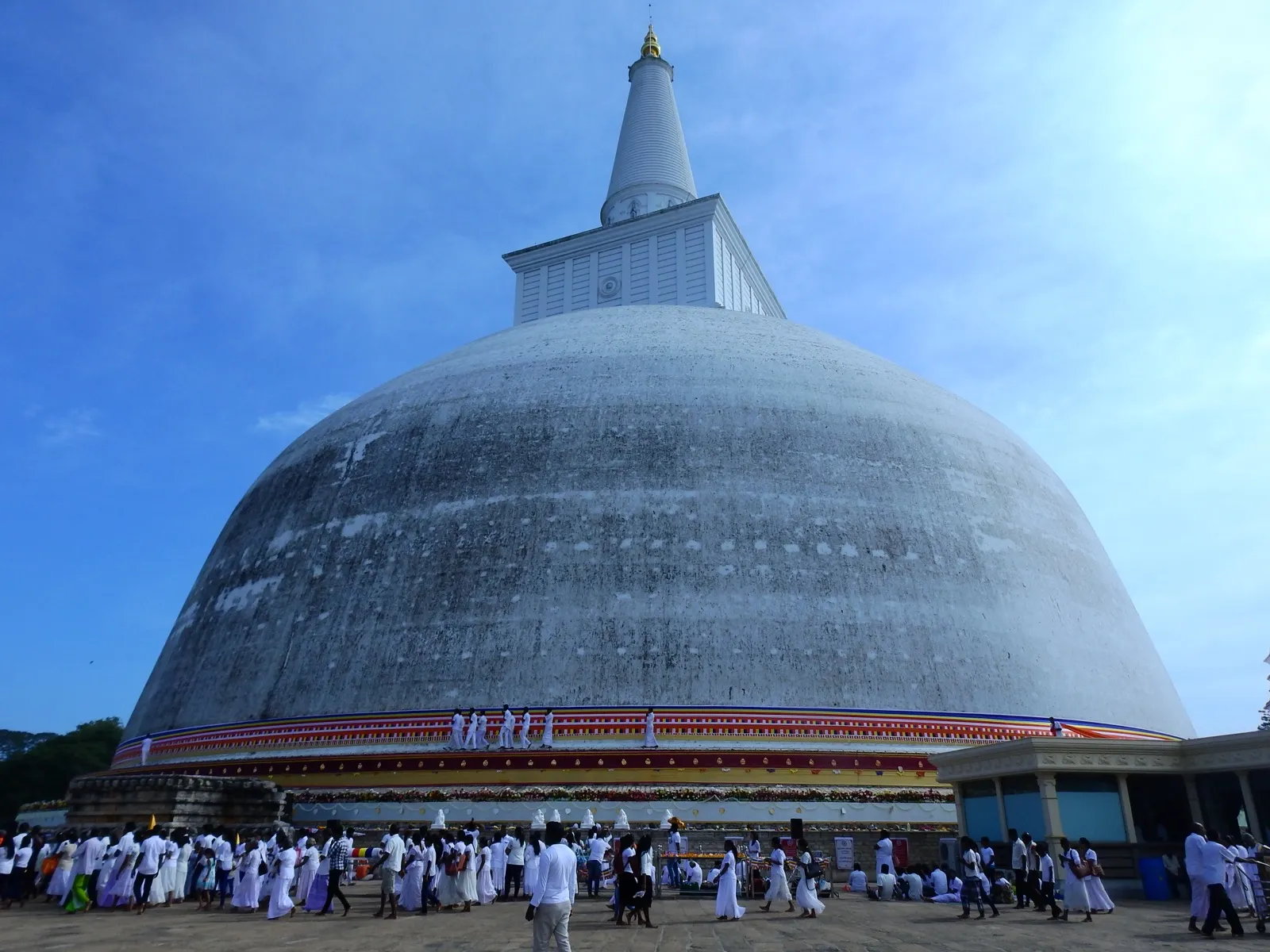
At a Buddhist temple in Sri Lanka, take off your shoes and your hat, and cover your shoulders and your knees. Never pose for a photo with your back to a Buddha statue, and never touch or climb on a statue. Speak quietly. Disrespect towards Buddhist images is a criminal matter in Sri Lanka, not only a question of manners.
Watch the one-minute version
The same answer as a one-minute Short. It plays from YouTube only when you press play.
These rules are simple, and Sri Lankans are patient with visitors who are trying. This guide explains each rule, the reason behind it, and how the rules change at Hindu, Muslim and Christian places of worship.
Why do Sri Lankan temples have these rules?
About seven in ten Sri Lankans are Buddhist. The 2024 census counted 69.8% Buddhists, 12.6% Hindus, 10.7% Muslims and 6.9% Christians (5.6% Roman Catholic, 1.3% other Christian). The Buddhism practised here is Theravada.
For the people around you at a temple, this is not a monument. It is a place of worship. The rules are how you show that you understand this.
What do dagoba, vihara and kovil mean?
- Dagoba: the Sri Lankan word for a stupa. It is a solid, bell- or dome-shaped monument that holds relics of the Buddha or of a revered monk. You cannot go inside it. You walk around it.
- Vihara (or viharaya): a Buddhist monastery or temple, where monks live. In Sri Lanka the word is used for the whole temple, including its shrine room with the Buddha images.
- Kovil: the word used in Sri Lanka for a Hindu temple, such as Nallur Kandaswamy Kovil in Jaffna.
- Bo tree: a sacred fig tree, the kind of tree under which the Buddha reached enlightenment. The Sri Maha Bodhi in Anuradhapura grew from a cutting of the tree at Bodh Gaya in India. It was brought to Sri Lanka in the third century BCE by the nun Sanghamitta. Bo trees at temples across the island are honoured in the same way.
- Poya: the full moon day, a Buddhist holy day.
What are the rules at a Buddhist temple?
What to wear to a temple in Sri Lanka
At a Buddhist temple, take off your shoes and your hat. Cover your shoulders and your knees: no shorts, no sleeveless tops.
Where do you take your shoes off?
Where exactly the shoes come off varies by temple. If you are not sure, watch what local people do.
Can you keep socks on?
Socks are a grey area. Many visitors keep them on when the stone is hot, and this is usually accepted.
The reason: you are dressing and behaving as the worshippers around you do, in a place that is sacred to them.
At the Temple of the Tooth in Kandy, staff turn away anyone in shorts or a sleeveless top, but they can give you a cover at the entrance. Our guide to what to wear at the Temple of the Tooth covers that temple in detail.
Can you take photos with a Buddha statue?
Do not pose for a photo with your back to a Buddha statue. The British and Canadian governments both warn about this. Canada says you can be fined, arrested or deported for posing next to a Buddha statue or for having your back to one. Do not climb on any statue or religious structure, and do not touch it.
The reason: a Buddha image is an object of devotion, not decoration. Turning your back on it to take a photo of yourself treats it as scenery.
Which way do you walk around a dagoba?
The traditional way to walk around a dagoba is clockwise, keeping it on your right. This is a gesture of respect. In Sri Lanka not everyone follows it strictly, but going clockwise is never wrong.
How should you sit in a shrine room?
When you sit down in a shrine room, tuck your legs to one side or under you, so the soles of your feet do not point at the Buddha image or at a monk. It is the polite way to sit.
Can you take photos inside a temple?
Keep your voice low and your phone on silent. Check the signs before you take photos: some temples ban photography inside, and many do not want flash, which can damage old paintings. Ask before you photograph a monk or a person at prayer.
Do you have to bring an offering?
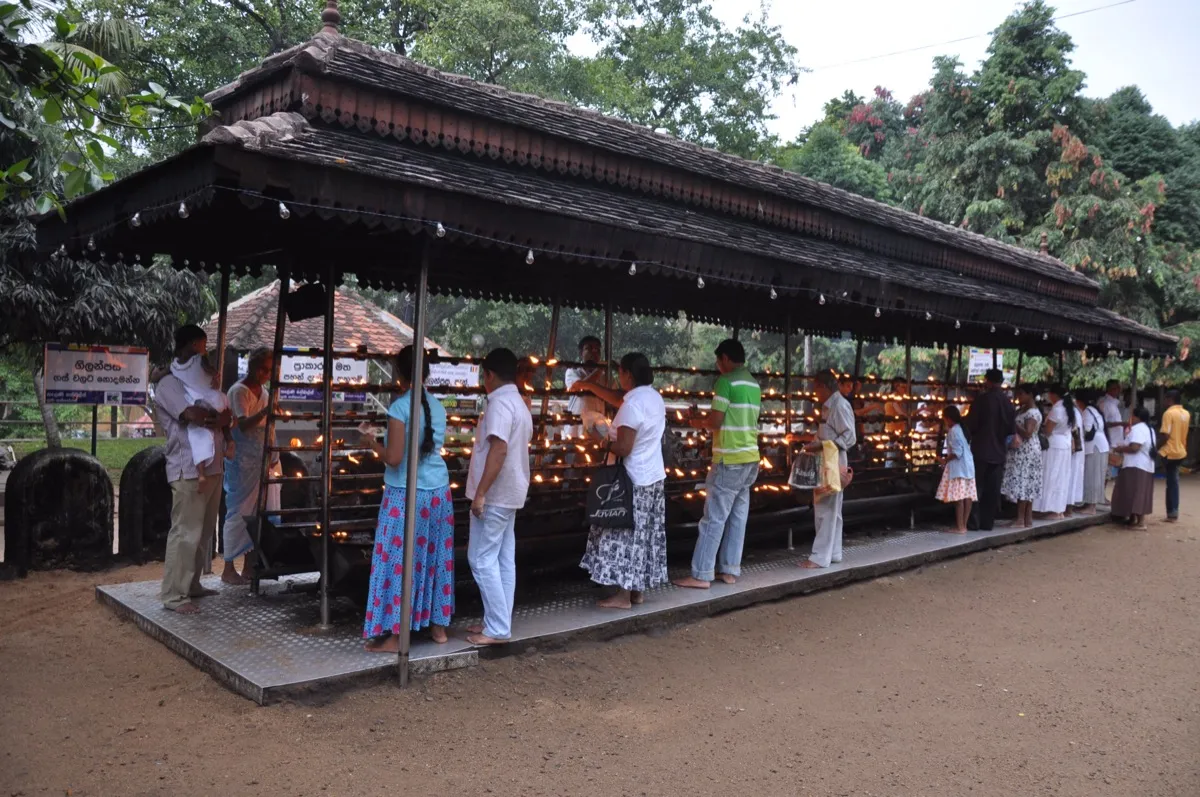
Local Buddhists offer flowers, light oil lamps and burn incense. At the Temple of the Tooth, jasmine flowers are offered at every daily service. You are welcome to offer flowers too, but you do not have to. If a monk shows you around, a small donation is expected. Do not bring offerings in plastic bags to the Temple of the Tooth.
How should you behave around monks?
Do not touch a monk, and do not try to shake his hand. This matters most for women: the monastic rules forbid a monk from physical contact with a woman, so monks keep their distance.
On public buses, the front seats are reserved for clergy. If you are sitting there and a monk gets on, give him the seat.
Is a Buddha tattoo a problem in Sri Lanka?
In Sri Lanka, disrespect towards Buddhist images is not only rude. It is a criminal matter. The UK government warns that disrespecting Buddhist images and artefacts, or making offensive remarks about religion, is a serious offence and can lead to arrest.
Sri Lanka's Penal Code has a whole chapter on offences relating to religion. It covers damaging or defiling a place of worship or a sacred object, acts near them that insult a religion, disturbing worship, and words, gestures or images meant to wound religious feelings. Penalties go up to two years in prison, a fine, or both.
Tattoos. The UK government states it plainly: if you have a visible tattoo of the Buddha, you can be refused entry to Sri Lanka or deported. Cover it with a sleeve or a dressing, especially at the airport and at temples.
In April 2014 a British nurse, Naomi Coleman, arrived at Colombo airport with a tattoo of the Buddha on her arm. She was arrested, held for several days and deported. She was a practising Buddhist. In 2017 Sri Lanka's Supreme Court ruled that the police had violated her fundamental rights. It ordered the state to pay her compensation and costs, and two police officers to pay her from their own pockets.
This is not a single case. In 2012 three French tourists were convicted over holiday photos in which one pretended to kiss a Buddha statue. They received suspended prison sentences and a fine. In 2013 a British man with a Buddha tattoo was turned back at Colombo airport.
The court ruling in Coleman's case matters: the arrest was found to be unlawful. But the practical advice does not change. If you have a Buddha tattoo, keep it covered.
What happens on Poya days?
Every full moon is a Poya day, a Buddhist holy day and a public holiday. By law, bars, liquor shops and meat stalls must close on Poya days, and no one may slaughter animals for sale or sell meat. Night clubs and casinos close too.
Do not expect to buy alcohol, and do not drink in public. Around Vesak and Poson, the liquor closures often last two or three days.
What are the rules at a Hindu kovil?
At a Hindu kovil, the shoe and dress rules are the same as at a Buddhist temple, and some kovils add more. At Nallur Kandaswamy Kovil in Jaffna, men must take off their shirts before they enter the inner sanctum. Women must keep their shoulders covered. Photography is not allowed inside. At some kovils, non-Hindus may not enter the inner shrine at all.
What are the rules at a mosque?
At a mosque, cover your shoulders and knees and take off your shoes. Women should carry a scarf to cover their hair. Avoid prayer times, especially Friday midday and afternoon. Not every mosque admits non-Muslim visitors, so ask at the gate first.
How do you greet people in Sri Lanka?
The Sinhala greeting is Ayubowan, which means "may you live long". People often say it with the palms pressed together.
Use your right hand to eat, to shake hands, and to give or receive things. Avoid kissing or embracing in public, and especially at temples.
What most visitors miss at Sri Lankan temples
- The rules are about the place. You are a guest in someone's place of worship.
- The photo rule is the one governments warn about. Posing with your back to a Buddha can lead to a fine, arrest or deportation.
- Tattoos count. A visible Buddha tattoo can get you refused entry or deported.
- Poya affects your evening. No alcohol sales, and meat stalls closed.
- Every faith has its own rules. A kovil and a mosque ask different things from a Buddhist temple.
- Watching helps. When unsure, do what the local worshippers do.
Before you visit a temple
- Clothes that cover shoulders and knees, or a scarf or sarong in your bag.
- Shoes you can take off easily.
- Hat off at every temple.
- No posing with your back to a Buddha statue; no touching or climbing statues.
- Any Buddha tattoo covered, from the airport onwards.
- Phone on silent; check the signs before any photo.
- A scarf for mosque visits (women).
- Poya dates checked for your trip.
Questions people ask
What should I wear to a temple in Sri Lanka?
Clothes that cover your shoulders and your knees: no shorts and no sleeveless tops. Take off your shoes and your hat before you enter.
Can I wear socks in a Sri Lankan temple?
Socks are a grey area. Many visitors keep them on when the stone is hot, and this is usually accepted. Watch what local people do.
Can I take a photo with a Buddha statue?
Do not pose with your back to a Buddha statue. Canada says you can be fined, arrested or deported for posing next to a Buddha statue or for having your back to one. Photograph the statue on its own.
Can I visit a temple with a Buddha tattoo?
Cover it. The UK government warns that a visible Buddha tattoo can get you refused entry to Sri Lanka or deported. Keep it covered at the airport and at temples.
Which way should I walk around a dagoba?
Clockwise, keeping it on your right. In Sri Lanka not everyone follows this strictly, but going clockwise is never wrong.
Coming soon: Sri Lanka Before You Land, our pre-trip ebook, explains the customs behind every temple on your route. A free guide, Your First Week in Sri Lanka, will cover the first days on the ground.
Sources (39)
Every fact in this guide was checked against these sources on 3 October 2026. Official and primary sources come first. How we research.
- UK FCDO, Sri Lanka travel advice: Safety and security > Laws and cultural differences · gov.uk
- Sri Lanka High Commission, New Delhi (official gov.lk site) · hc-newdelhi.gov.lk
- Ireland DFA, Sri Lanka travel advice · ireland.ie
- Holidays Act No. 29 of 1971, arrangement of sections (government host most.gov.lk) — confirms s.13 'Closure of certain establishments' and s.14 'Prohibition of slaughter of animals' · most.gov.lk
- National Transport Commission, 2024 passenger complaint summary · ntc.gov.lk
- Australian Government Smartraveller, Sri Lanka — Local laws · smartraveller.gov.au
- Sri Dalada Maligawa official site, Daily Service (Theva) · sridaladamaligawa.lk
- Sri Dalada Maligawa official site, FAQ / entrance guidelines · sridaladamaligawa.lk
- Department of Census and Statistics, Census of Population and Housing 2024 press release (PDF) · statistics.gov.lk
- Government of Canada, Sri Lanka travel advice, Laws and culture (last updated 07 July 2026) · travel.gc.ca
- US Department of State, Sri Lanka travel advisory / country information · travel.state.gov
- UNESCO World Heritage Committee Decision 40 COM 7B.46 (2016), Golden Temple of Dambulla · whc.unesco.org
- UNESCO World Heritage List, Sacred City of Anuradhapura · whc.unesco.org
- Nallur Kandaswamy Devasthanam official site, Guidelines · nallurkandaswamydevasthanam.org
- Nallur Kandaswamy Devasthanam official site, home page guidelines · nallurkandaswamydevasthanam.org
- ABC News (Australia), 'Sri Lanka convicts tourists over Buddha photos', 22 Aug 2012 · abc.net.au
- Access to Insight, Glossary of Pali terms ('stupa') · accesstoinsight.org
- All Ceylon Jamiyyathul Ulama clarification, 4 May 2026, quoting Holidays Act s.14 · acju.lk
- Ada Derana, 'British woman arrested over Buddha tattoo to be compensated', 15 Nov 2017 · adaderana.lk
- Al Jazeera, 'Sri Lanka expels tourist with Buddha tattoo', 24 Apr 2014 · aljazeera.com
- Al Jazeera, 'Sri Lanka to expel tourist with Buddha tattoo', 23 Apr 2014 · aljazeera.com
- Encyclopaedia Britannica, 'Anuradhapura' · britannica.com
- Encyclopaedia Britannica, 'Kandaswamy Kovil' · britannica.com
- Encyclopaedia Britannica, 'stupa' · britannica.com
- Encyclopaedia Britannica, 'vihara' · britannica.com
- Thanissaro Bhikkhu, The Buddhist Monastic Code, ch.5 Sanghadisesa, rule 2 · dhammatalks.org
- Daily FT, 'Briton denies Buddha tattoo was disrespectful', 15 Mar 2013 · ft.lk
- Daily FT, 'Ordeal of British lady with Buddha tattoo: SC awards Rs. 600, 000 as compensation', 16 Nov 2017 · ft.lk
- Holidays Act No. 29 of 1971, full text (ss.2, 13, 14) — lankalaw.net, private law-reference host · lankalaw.net
- Lonely Planet, Best things to do in Colombo · lonelyplanet.com
- Lonely Planet, Masjid Jami-Ul-Alfar listing · lonelyplanet.com
- Lonely Planet, Things to know before traveling to Sri Lanka · lonelyplanet.com
- Newsfirst, 'All liquor shops to be closed for Poson for 3 days', 28 Jun 2026 · newsfirst.lk
- Rough Guides, Customs and etiquette in Sri Lanka · roughguides.com
- Sunday Times (LK), 13 Jan 2013, 'CCTV inside buses to ensure passenger safety' · sundaytimes.lk
- Sunday Times (LK), 15 Jul 2001, feature on front-row seats · sundaytimes.lk
- The Morning (LK), 'Excise dept. announces compulsory closure days for liquor shops', 15 Jan 2025 · themorning.lk
- UNAFEI Resource Material Series No.108, W. Jayasundara, 'Criminal justice response to crime motivated by intolerance and discrimination' (Sri Lanka) · unafei.or.jp
- Penal Code (Sri Lanka), Chapter XV 'Of offences relating to religion', ss.290-292 — full-text copy hosted by Warnath Group (unofficial host; official LawNet/CommonLII copies blocked by Cloudflare) · warnathgroup.com
Related guides
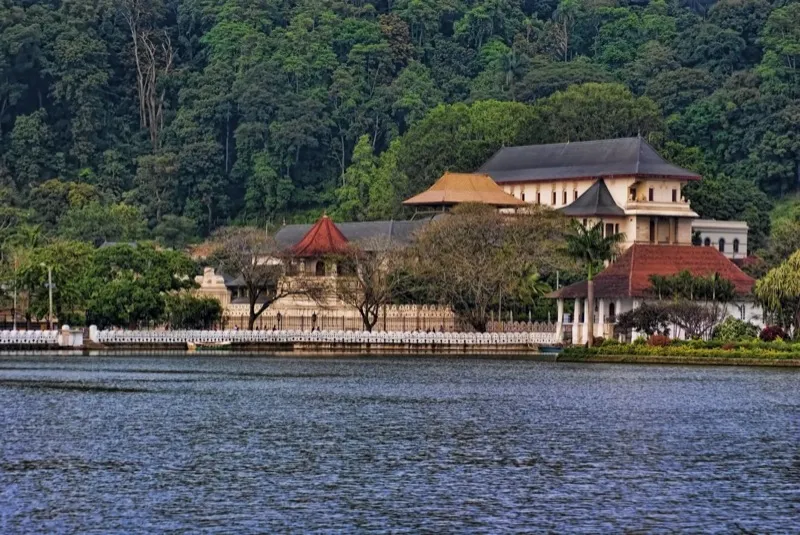
What to wear at the Temple of the Tooth, and why
Cover shoulders and legs, no shorts or sleeveless tops, hat off, shoes left at the booth. The Temple of the Tooth dress code, explained (October 2026).
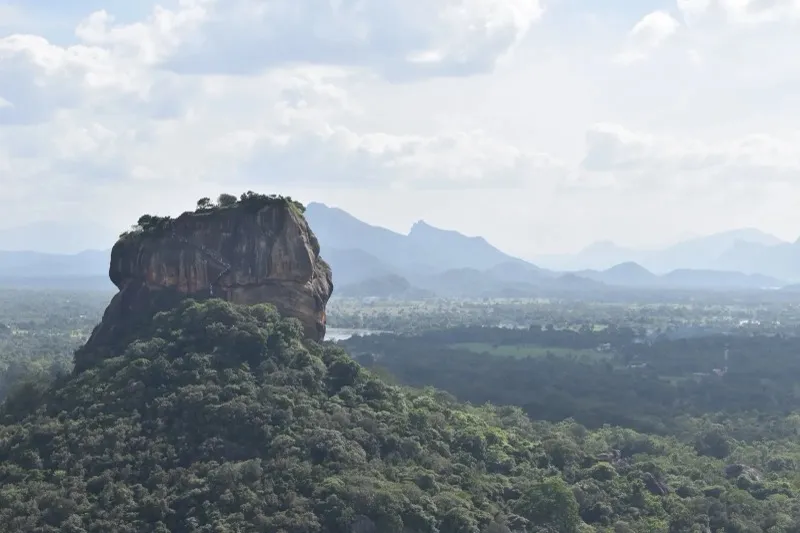
Sigiriya or Pidurangala? What each climb gives you
Climb Sigiriya to understand the site; climb Pidurangala to see the rock itself. Many visitors do both in one day. What each climb involves (October 2026).
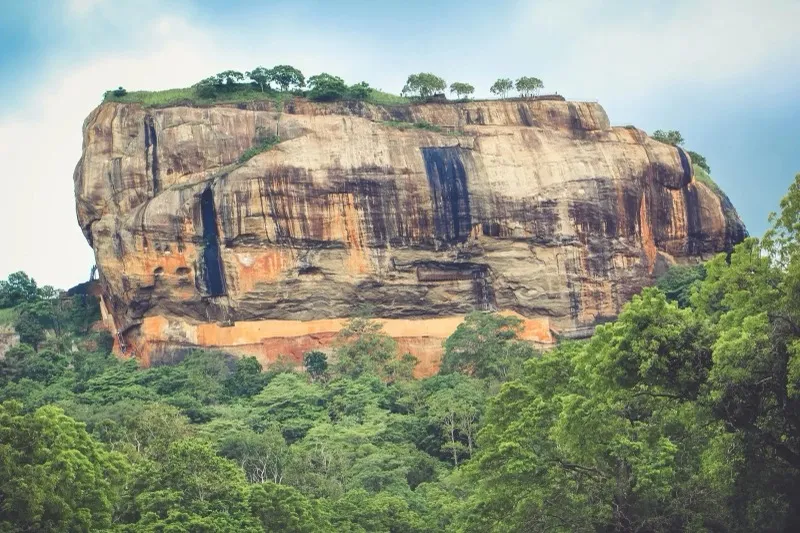
Is Sigiriya worth climbing? What you see, and what most visitors miss
Yes, if you know what you are looking at: a 5th-century royal capital on a 180 m rock. What the climb involves, the fee, and what most visitors miss.
More guides in Culture and etiquette