Wilpattu National Park: villus, leopards and what a safari there is like
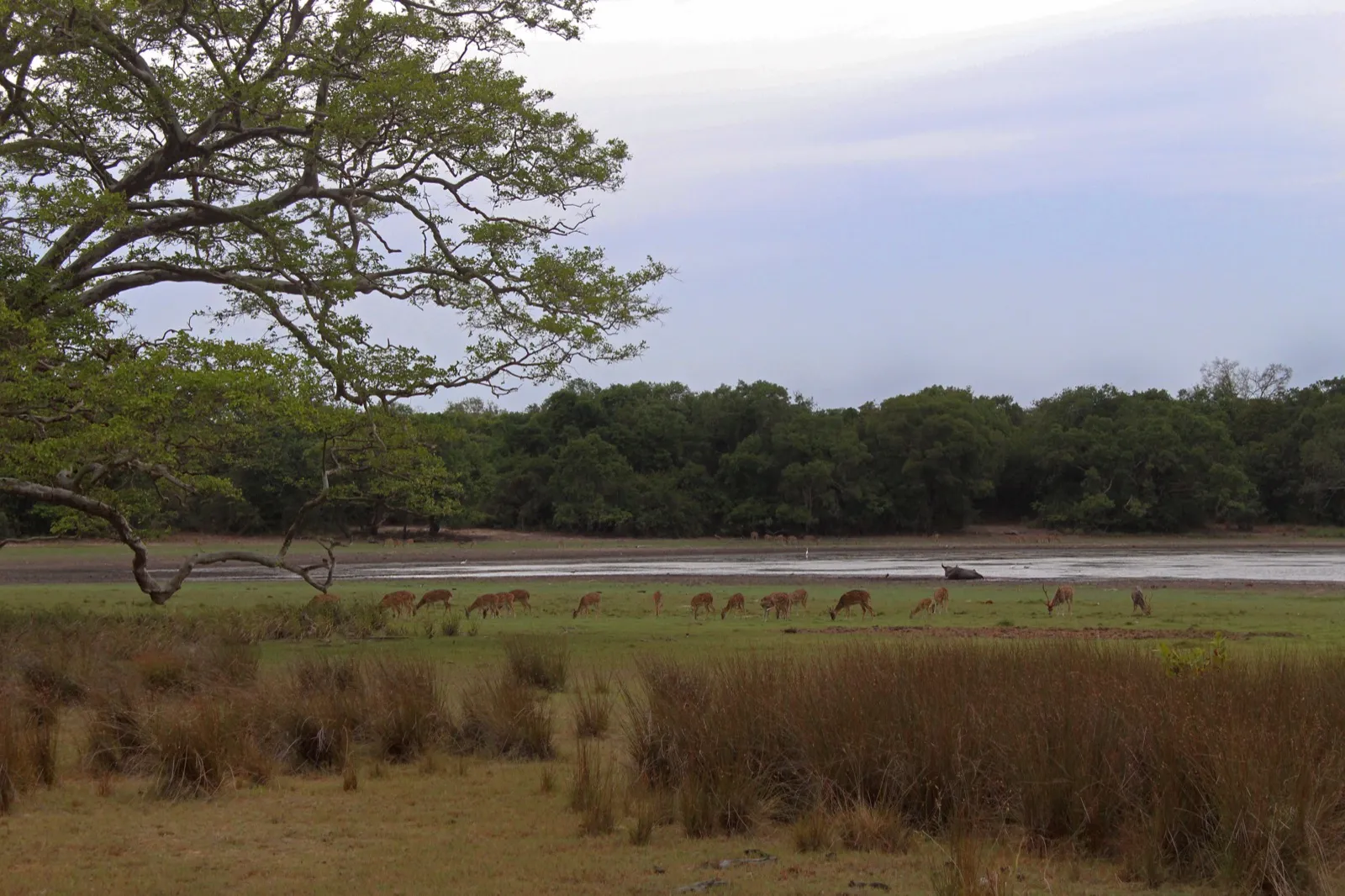
Wilpattu is Sri Lanka's largest national park, about 1,317 square kilometres of dry forest around some forty natural lakes called villus. Camera-trap studies put its leopard density close to Yala Block I's, with about a fifth of Yala's visitors. Go in the dry season, about May to mid-October, entering at Hunuwilagama, about 40 km from Anuradhapura.
This guide explains what makes Wilpattu different, when to go, what a safari involves, and how to choose between Wilpattu and Yala.
What is Wilpattu National Park?
Wilpattu was declared a national park in 1938. With Yala, it is one of Sri Lanka's two oldest national parks. It covers about 1,317 square kilometres, which makes it Sri Lanka's largest national park.
Wilpattu is on Sri Lanka's north-west coast, in the dry zone, about 30 kilometres west of the ancient city of Anuradhapura. Most of it is dry forest and thorny scrub, broken by open plains around the villus. Two rivers mark its edges: the Kala Oya in the south and the Modaragam Aru in the north. To the west is the sea.
Wilpattu and its coast were listed as a wetland of international importance under the Ramsar Convention in 2013.
The park was closed to visitors for long periods during Sri Lanka's civil war, and fully reopened in 2010, after the war ended.
What is a villu?
Wilpattu's best-known feature is its villus: about forty natural, shallow, saucer-shaped basins rimmed with sand, which fill with rainwater. They look like lakes but have no stream flowing in or out. A few are salty. Animals gather around them, and most jeep routes visit a cluster of them in the middle of the park.
Can you see leopards in Wilpattu?
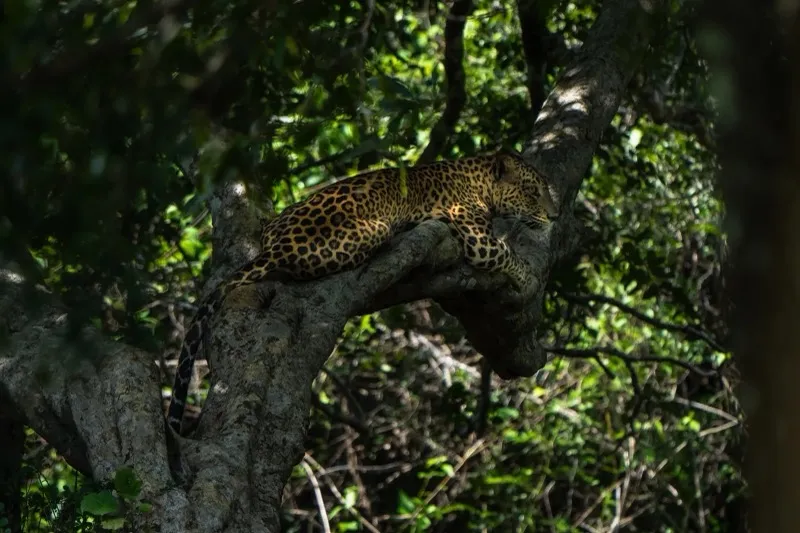
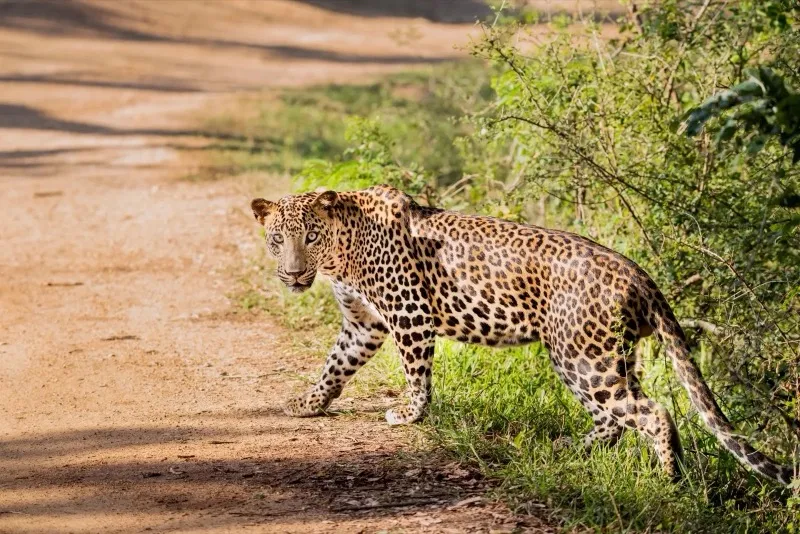
Yes. Wilpattu has a healthy leopard population. A camera-trap study in the park's interior estimated about 10 adult leopards per 100 square kilometres, and a later study estimated about 18. That is similar to Yala's Block I. The same research found leopards keep away from the park's edges, where people disturb them.
Camera traps in Wilpattu show its leopards are active mostly at night and around dusk, and least active in the middle of the day. Parks are closed at night, so the early morning and the late afternoon give you the best chance of seeing one.
The Sri Lankan leopard is a subspecies found only in Sri Lanka. The IUCN Red List lists it as Vulnerable since its 2020 assessment. Fewer than 1,000 adult leopards are thought to live on the island.
What other animals live in Wilpattu?
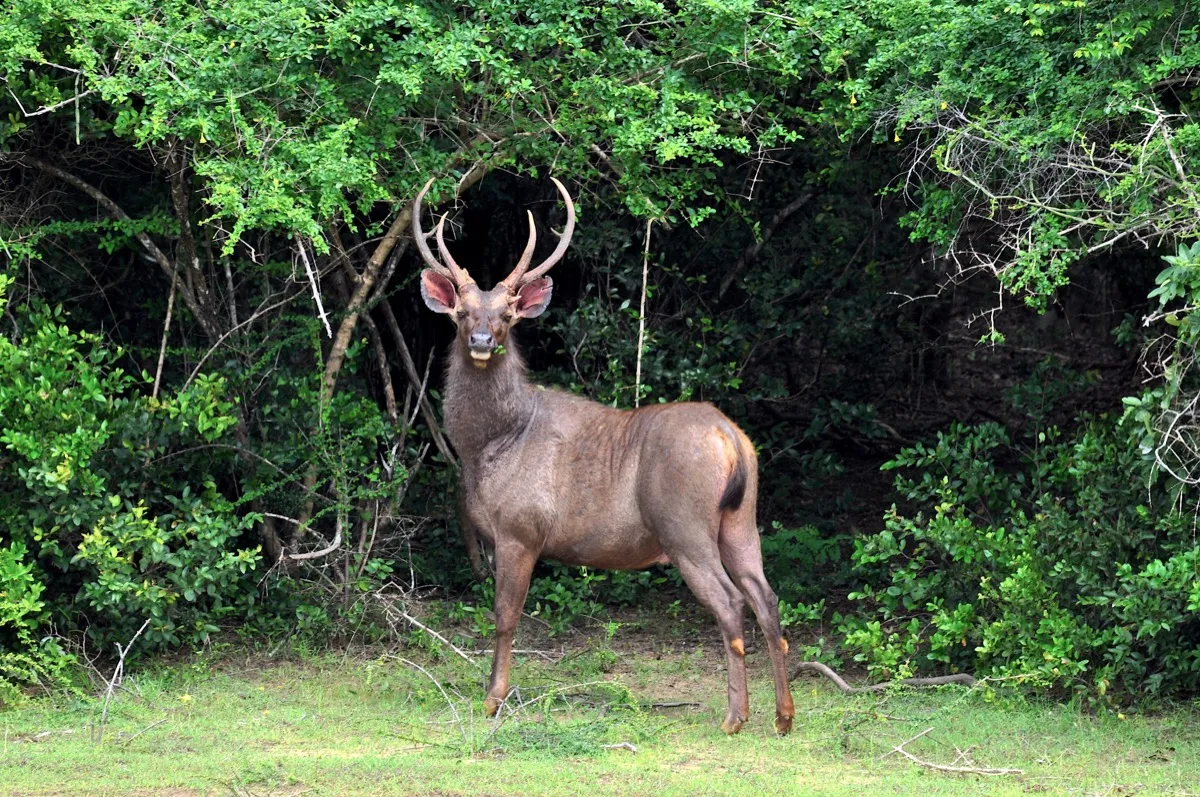
Besides leopards, Wilpattu has sloth bears, Asian elephants, spotted deer, sambar, wild water buffalo and mugger crocodiles.
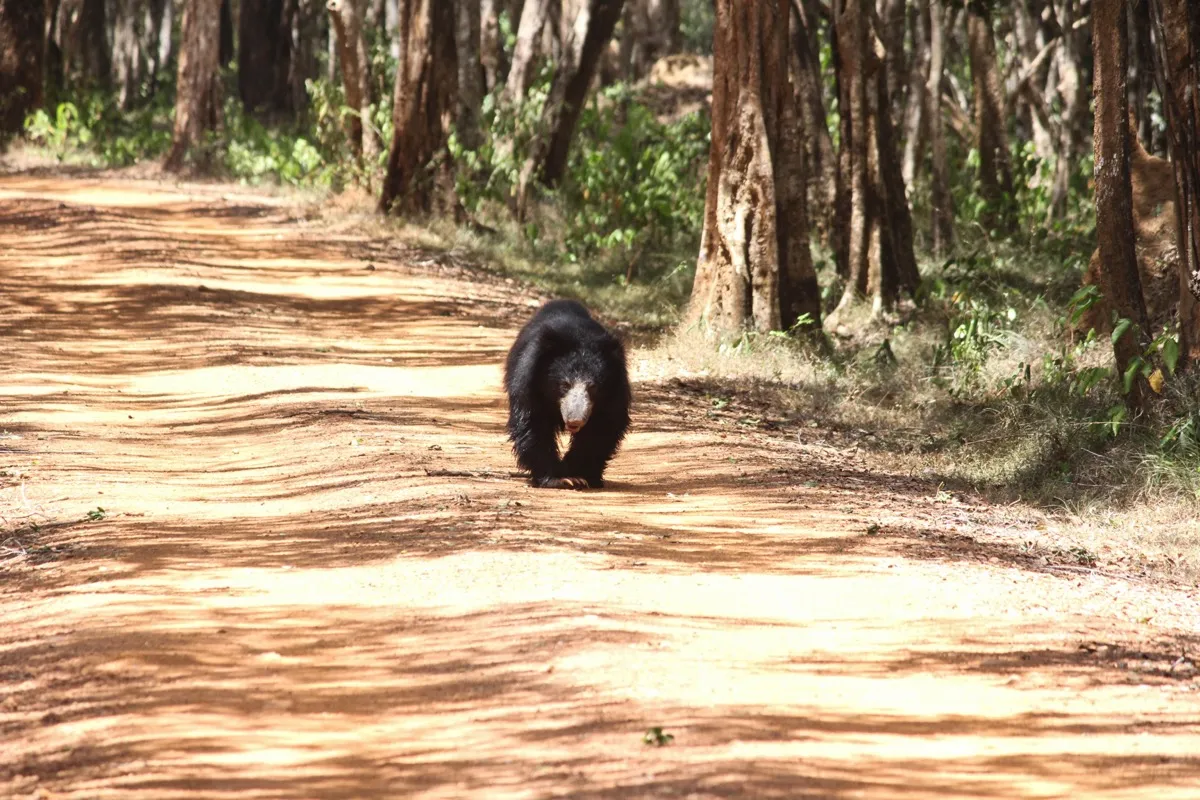
Wilpattu is one of the best places in Sri Lanka to see a sloth bear, though they are shy and sightings are never certain. The best chance is when palu trees are fruiting, usually around May to July.
When is the best time to visit Wilpattu?
Wilpattu is in the dry zone, with about 1,000 millimetres of rain a year. Most rain falls from mid-October to December. The long dry season runs from about May to mid-October, when the villus shrink and animals gather around the water that is left, which is why many visitors prefer those months.
Is Wilpattu less crowded than Yala?
Yes. Wilpattu is far quieter than Yala. In 2024 it had about 130,000 visitors, about one-fifth of Yala's 647,000.
How do you get to Wilpattu?
The main entrance and park office are at Hunuwilagama, on the eastern side, on the Anuradhapura side of the park. There is a second entrance at Eluwankulama, on the Puttalam side.
Wilpattu's main entrance at Hunuwilagama is about 40 km by road from Anuradhapura, the nearest city; allow roughly 1 to 1.25 hours (estimate, checked October 2026). That makes it a good addition to a visit to Anuradhapura.
How much does a Wilpattu safari cost?
The national park fees in force were set by Government Gazette 2292/11, published on 8 August 2022, and have applied since 2 September 2022. As checked in October 2026, this was the latest official fee table we could confirm. Wilpattu is in the top fee band, with Yala and Udawalawe.
- A foreign adult pays 25 US dollars for a daytime visit in the tourist season, or 20 dollars at other times.
- A child aged 6 to 12 pays 15 or 10 dollars, and children under 6 enter free.
- Each group also pays a service charge of 10 dollars per vehicle, and a jeep fee of 300 rupees.
- Taxes are added on top, so the final price is higher. Jeep hire is separate.
How does a Wilpattu safari work?
Day visits run from 6 in the morning to 6 in the evening. You need a park permit for each visit. Your jeep driver usually buys it at the gate, or it can be booked online through the Department of Wildlife Conservation's e-permit service. Carry your passport: no one is let in without an identity document.
The wildlife department runs bungalows and campsites inside Wilpattu, booked separately from a day safari.
What are the rules inside the park?
Stay inside the jeep. Do not feed any animal. Keep quiet and do nothing that disturbs the wildlife; causing a disturbance in a national park is against the law. Jeeps must stay on the marked tracks, give animals right of way, and keep to the legal speed limit inside the park of 20 km/h. Ask your driver to keep a good distance and never to block an animal's path.
Wilpattu or Yala?
- Choose Wilpattu for fewer jeeps, the villus, and a good chance of sloth bears in season.
- Choose Yala if you are on the south loop, or if you want the park where leopards are most used to vehicles.
- Either way, leopards are most active at dusk and night, so book early-morning and late-afternoon drives.
See which safari in Sri Lanka for every park, and leopards in Yala for Yala.
What most visitors miss
- The villus are natural, not reservoirs.
- Leopards keep away from the edges, so the interior drives matter.
- Wilpattu is the largest park but has about a fifth of Yala's visitors.
- Bring your passport for the permit.
Before you go to Wilpattu
- A dry-season date, about May to mid-October.
- An early start from Anuradhapura, about 1 to 1.25 hours away.
- Your passport for the permit.
- The 2022 fees plus service charge, jeep fee and taxes; jeep hire separate.
- A driver who will keep distance and not block animals.
Questions people ask
Is Wilpattu good for leopards?
Yes. Camera-trap studies in the park's interior estimated about 10 and about 18 adult leopards per 100 square kilometres, similar to Yala's Block I.
What is the best time to visit Wilpattu?
The long dry season, from about May to mid-October, when the villus shrink and animals gather at the water. Most rain falls from mid-October to December.
How far is Wilpattu from Anuradhapura?
The main entrance at Hunuwilagama is about 40 km by road, roughly 1 to 1.25 hours (estimate, checked October 2026).
How much is the Wilpattu entry fee?
Under the 2022 fee table, a foreign adult pays 25 US dollars in the tourist season or 20 dollars at other times, plus a 10-dollar service charge per vehicle, a jeep fee and taxes (as checked October 2026).
Is Wilpattu less crowded than Yala?
Yes. In 2024 it had about 130,000 visitors, about one-fifth of Yala's 647,000.
Coming soon: Sri Lanka Before You Land, our pre-trip ebook, explains how to watch Sri Lanka's wildlife without harming it. A free guide, Your First Week in Sri Lanka, will cover the first days on the ground.
Sources (16)
Every fact in this guide was checked against these sources on 3 October 2026. Official and primary sources come first. How we research.
- DWC e-permit how-to · dwc.gov.lk
- DWC notice on the 2022 fee revision · dwc.gov.lk
- DWC, National Park page · dwc.gov.lk
- DWC e-permit service · dwc.lankagate.gov.lk
- Fauna and Flora Protection Ordinance · faolex.fao.org
- DWC Performance Report 2024 (tabled in Parliament) · parliament.lk
- Ramsar Information Sheet, Wilpattu Ramsar Wetland Cluster, site no. 2095 (designated 02/02/2013), submitted by Sri Lanka · rsis.ramsar.org
- SLTDA Guideline for Vehicle Safari Tour Operations (Feb 2024) · sltda.gov.lk
- Kittle, Watson & Samaranayake 2021, Journal of Zoology 314:31-42 · doi.org
- Kittle & Watson, PLOS ONE 2026, leopard temporal partitioning (camera traps incl. Wilpattu) · journals.plos.org
- PLOS ONE 2026 Table 3 (leopard SECR densities) · journals.plos.org
- Gazette Extraordinary 2292/11, 8 Aug 2022 (national reserve fees and permit conditions) · web.archive.org
- Ada Derana, 15 Jun 2026 · adaderana.lk
- Uduman et al. 2021, Oryx · cambridge.org
- Mongabay, 29 Mar 2025 · news.mongabay.com
- Sunday Times 2005 (Tree Society) on palu · sundaytimes.lk
Related guides
Which safari in Sri Lanka? A one-screen chooser by goal and month
Leopards: Yala or Wilpattu. Elephants: Udawalawe all year, Minneriya in the dry season. Birds: Bundala or Kumana. Which park, which month (October 2026).
When to see leopards in Yala, and how to choose a responsible safari
Leopards are seen in Yala all year. Best odds: the first and last hours of the day, in the drier May to September months. Fees, rules and ethical choices.
Anuradhapura in a day: what to see in the first capital
One day: the Sri Maha Bodhi, the great dagobas, the Samadhi Buddha and the Twin Ponds. What each is, the US$30 ticket and getting around (Oct 2026).
More guides in Wildlife