Polonnaruwa: how to see the medieval capital by bicycle
Polonnaruwa, Sri Lanka's capital from the late 10th century to the 13th, is known for the rock-cut Buddhas of Gal Vihara, the Quadrangle with its round Vatadage, and the Royal Palace. The ruins run about 4 km on mostly flat ground, so many visitors cycle, starting at the museum. The foreign adult ticket is US$30 (as checked October 2026).
This guide explains what the city was, what each main ruin is, a route for the day, and the practical details for a visit in the heat.
What was Polonnaruwa?
Polonnaruwa became Sri Lanka's capital after Anuradhapura was destroyed in 993. First the Cholas of South India ruled from here. In 1070 King Vijayabahu I drove them out and kept Polonnaruwa as his capital. It stayed the capital until the 13th century.
Polonnaruwa's greatest king was Parakramabahu I, who ruled from 1153 to 1186. He created the huge reservoir beside the city, the Parakrama Samudra, the "Sea of Parakrama", joining and enlarging older tanks. It is still there. A tank is the Sri Lankan word for a reservoir.
Polonnaruwa is a UNESCO World Heritage Site. UNESCO lists it as the "Ancient City of Polonnaruwa". It was inscribed in 1982.
Can you see Polonnaruwa by bicycle?
The ruins spread over about 4 kilometres from north to south. From the museum to Gal Vihara is about 3 kilometres, and Potgul Vihara, at the southern end, is about 5 kilometres by road from Gal Vihara. Seeing everything takes a long day.
Many visitors see the ruins by bicycle. The ground is mostly flat and the sights are kilometres apart. Bicycles are for hire in Polonnaruwa town. This is travellers' advice, not an official scheme: the Central Cultural Fund publishes no rule about cycling inside the site. If cycling in the heat is not for you, a tuk-tuk or a car with a driver works too.
Should you visit the Polonnaruwa museum first?
The archaeological museum has models showing how the buildings looked with roofs and wooden walls, and a room of Hindu bronzes. It helps to see it before the ruins. Photos are not allowed inside.
Seeing the models first changes the day. The brick walls you then cycle past stop being ruins and become buildings with roofs, rooms and people.
What is the best route through Polonnaruwa?
A sensible order: start at the museum, then the Royal Palace and the Council Chamber, then the Quadrangle, which lies north of the palace, then the Shiva temples and Rankot Vihara, then the Lankatilaka and Kiri Vehera in the north of the site, and finish at Gal Vihara, about 3 km from the museum. Potgul Vihara, at the southern end, is about 5 km by road from Gal Vihara, so treat it as optional.
The Royal Palace and the Council Chamber
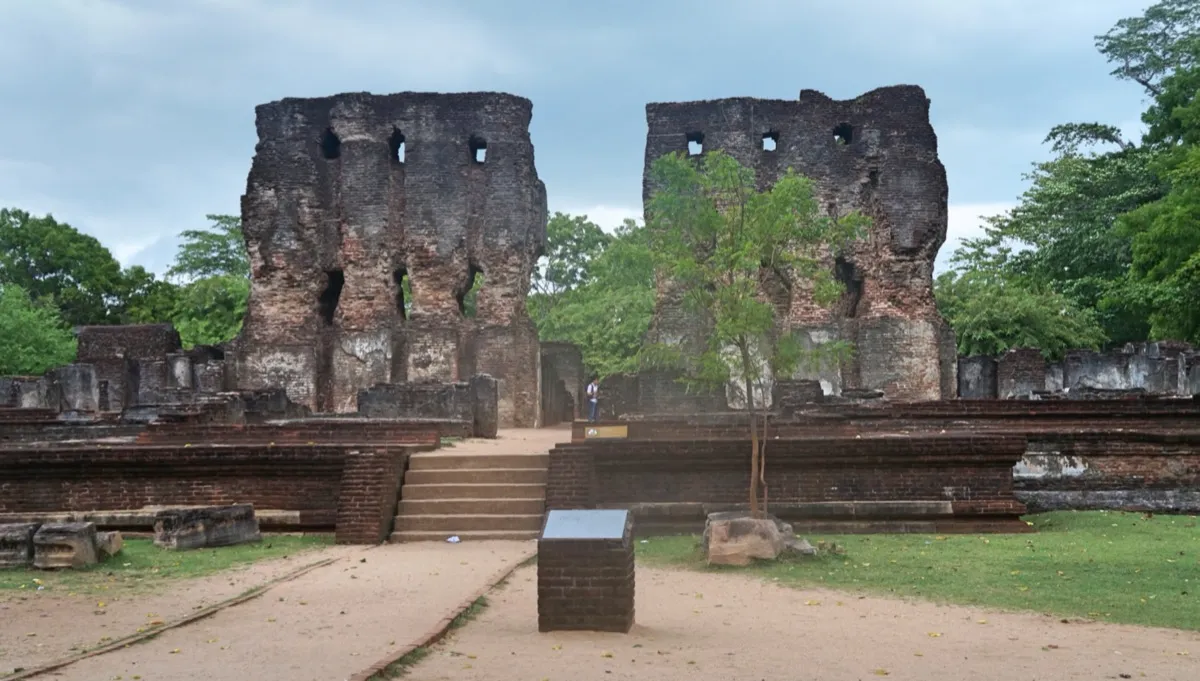
The Royal Palace of Parakramabahu is a massive brick building. The old chronicles say it was seven storeys high, with a thousand rooms. Today its thick brick walls still stand about two storeys high.
Inside the old citadel, beside the palace, are the stone remains of the Council Chamber, where the king met his ministers.
The Quadrangle
North of the palace is the Quadrangle, a tight group of shrines and the finest set of ruins in the city. In Polonnaruwa's time the Buddha's Tooth Relic was kept here. Today the relic is in the Temple of the Tooth in Kandy.
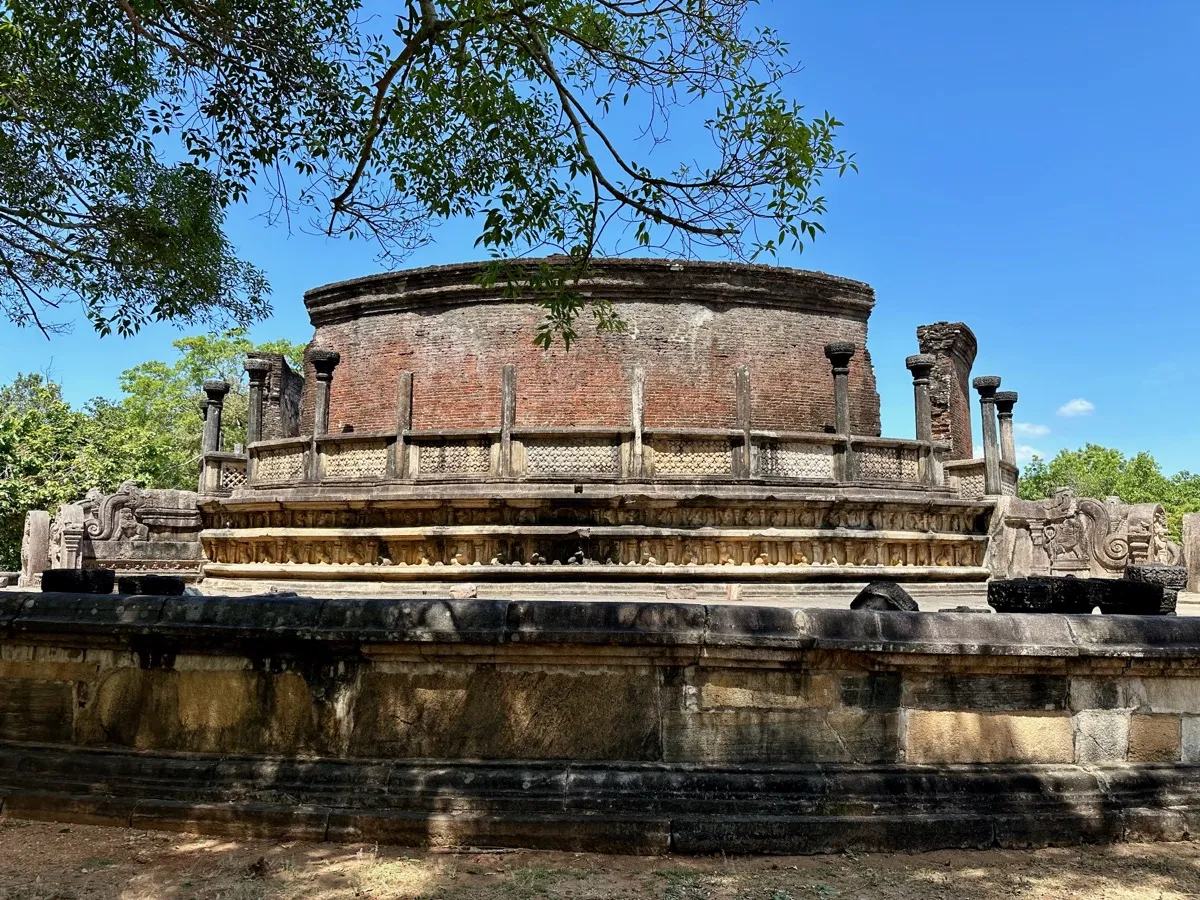
The Vatadage is a round shrine built around a small stupa. It stands on a raised, carved stone platform, ringed by slender stone pillars that once held up a roof. It is in the Quadrangle, and many think it is the finest building in Polonnaruwa.
The Shiva temples
Polonnaruwa is not only Buddhist. The Cholas built Hindu temples here, and two stone temples to Shiva, Siva Devale No. 1 and No. 2, still stand.
Rankot Vihara
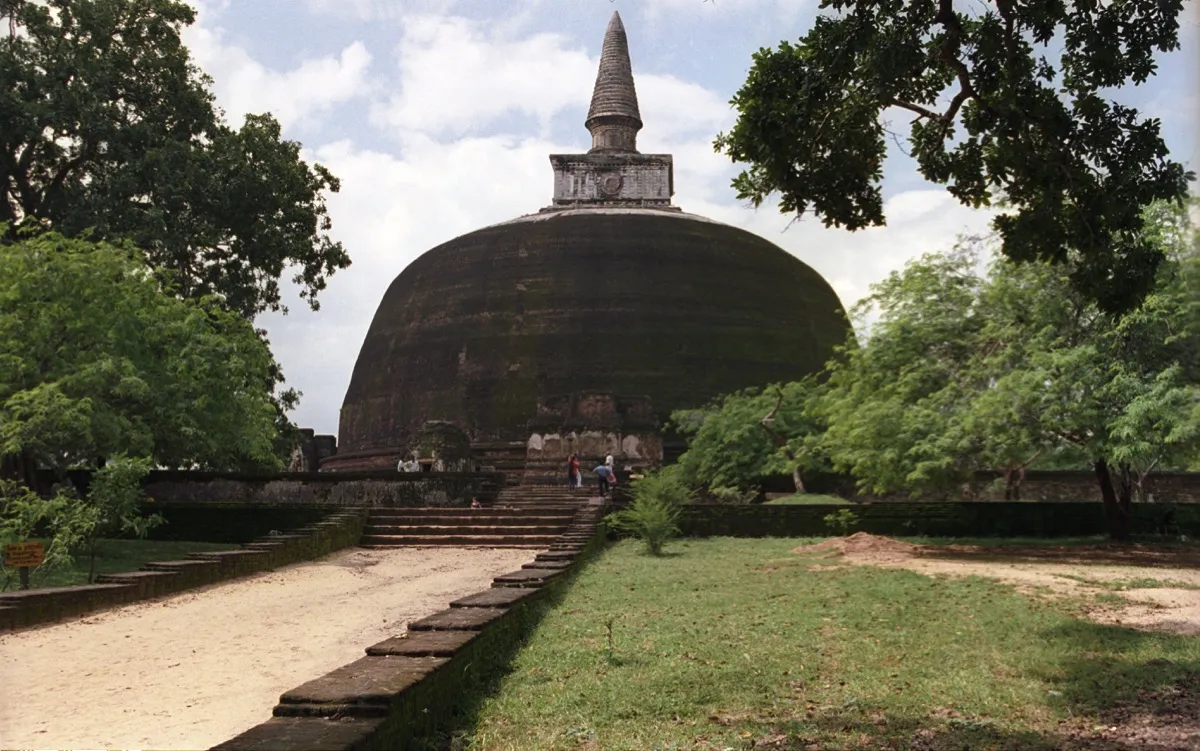
Rankot Vihara and Kiri Vehera are Polonnaruwa's great stupas. Rankot Vihara is built of brick on the scale of the giant stupas at Anuradhapura. It is linked to King Nissanka Malla, who left an inscription there.
The Lankatilaka and Kiri Vehera
The Lankatilaka is a huge brick image house from Parakramabahu's reign. Its tall walls still frame a giant standing Buddha, also made of brick, now weathered.
Kiri Vehera is the second of Polonnaruwa's great brick stupas. It stands in the north of the site, beside the Lankatilaka.
Gal Vihara: the rock-cut Buddhas
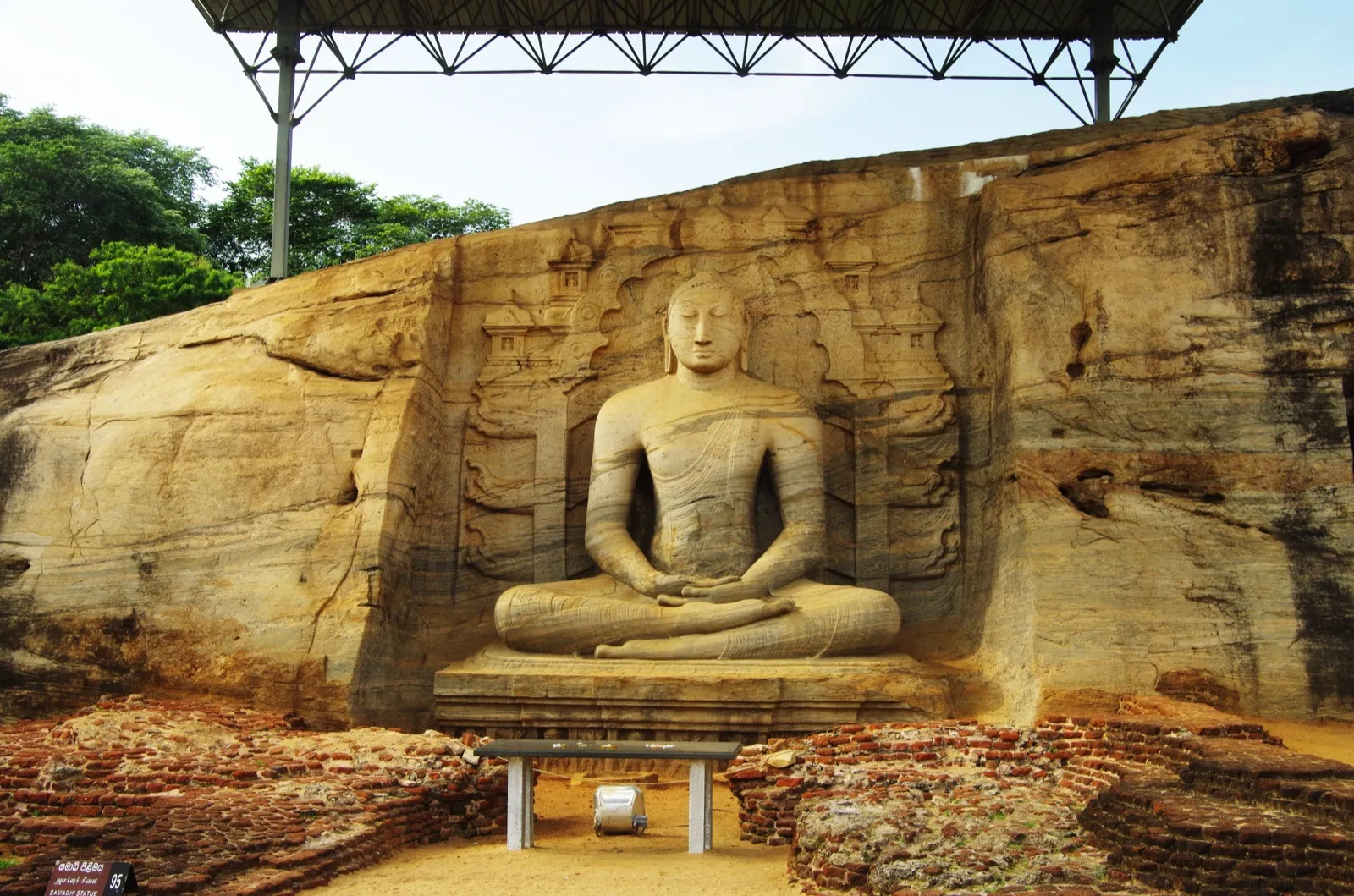
Gal Vihara is Polonnaruwa's most famous sight: four large figures cut into one long face of granite. There are two seated Buddhas, one of them in a small cave cut into the rock, a standing figure, and a reclining Buddha about 14 metres long, shown at the moment of his passing from the world.
This is a sacred place, not a photo backdrop. Do not pose for a photo with your back to a Buddha image, and do not touch the statues. At Polonnaruwa this is not just etiquette: the Central Cultural Fund lists it among the actions that are prohibited.
Optional: Potgul Vihara, a king or a sage?
At the south end of the site, near the lake, a tall figure is carved into a boulder. Many people call it King Parakramabahu, but no one knows for sure. The Central Cultural Fund says it has been read as either a king or a sage. Potgul Vihara is about 5 kilometres by road from Gal Vihara, so decide whether to include it before you set off.
How much is the Polonnaruwa ticket, and when does it open?
Foreign visitors need a ticket. Buy it at the Central Cultural Fund ticket counter at the site, or order it online in advance and collect it at the counter. The ticket is valid for one entry, on the day it is issued.
A full ticket for a foreign adult costs US$30, charged in rupees (10,020 rupees in late September 2026). Children aged 6 to 12 pay US$15. Ticket counters are open from 7 a.m. to 5 p.m., and the museum from 7 a.m. to 6 p.m. (as checked October 2026).
What should you wear in Polonnaruwa?
Polonnaruwa is in Sri Lanka's hot, dry zone. Start when the ticket counter opens at 7 a.m., or go in the late afternoon. Carry water and a hat. Barefoot on stone at midday is painful, and socks are accepted.
Many of the ruins are still sacred. Signs at the shrines ask you to take off your shoes, and you should take off your hat too. Cover your shoulders and knees. Wear shoes you can slip on and off easily; on a bicycle day you will do it many times. See temple etiquette in Sri Lanka.
What are the rules at the Polonnaruwa site?
- Do not bring plastic bags or plastic containers into the site: the Central Cultural Fund does not allow them.
- Music, loudspeakers and alcohol are not allowed, and you should eat only in the places set aside for it.
- Flying a drone or filming for commercial use needs written permission from the Central Cultural Fund in advance.
Toque macaques live among the ruins. Scientists have studied the monkeys of Polonnaruwa for decades. They are wild and they take food. Do not feed or touch them, and keep food out of sight, including in a bicycle basket.
Polonnaruwa or Anuradhapura?
They are two different capitals. Anuradhapura was the island's capital for about 1,300 years, from the 4th century BCE until 993 CE, and much of it is still a living place of worship; its ruins spread over a large area, several kilometres across. Polonnaruwa became the capital after Anuradhapura fell, and its ruins are more compact, running about 4 km from north to south. From Sigiriya, Polonnaruwa is about 55 km away by road and Anuradhapura about 75 km (estimates, checked October 2026). See Anuradhapura in one day.
How far is Polonnaruwa from Sigiriya and Kandy?
Polonnaruwa is about 55 km from Sigiriya, about 1.5 to 2 hours by road (estimate, checked October 2026). From Kandy it is about 140 km, about 3.5 to 4.5 hours by road (estimate, checked October 2026). You can visit as a day trip from the Sigiriya area; see our two-week itinerary. For the elephants nearby, see the Gathering at Minneriya.
What most visitors miss in Polonnaruwa
- The museum first. Its models explain what the ruins were.
- The Shiva temples. Polonnaruwa was also a Hindu city under the Cholas.
- The reservoir. Parakramabahu's "Sea" is still in use beside the ruins.
- The Potgul figure. King or sage: nobody knows for sure.
- The Tooth Relic's story. It was kept in the Quadrangle before it moved to Kandy.
Before you visit Polonnaruwa
- Start at 7 a.m., when the ticket counter opens.
- US$30 per foreign adult, charged in rupees (as checked October 2026).
- A bicycle hired in town, or a tuk-tuk or driver.
- Water, a hat and socks for hot stone.
- Clothes that cover shoulders and knees; slip-on shoes.
- No plastic bags, and food kept away from the monkeys.
- No posing with your back to a Buddha image, and no touching the statues.
Questions people ask
How much is the Polonnaruwa ticket for foreigners?
A full ticket for a foreign adult costs US$30, charged in rupees (10,020 rupees in late September 2026). Children aged 6 to 12 pay US$15. Buy it at the Central Cultural Fund counter at the site, or order it online and collect it there.
How long do you need in Polonnaruwa?
The ruins spread over about 4 kilometres from north to south, and seeing everything takes a long day. Start when the ticket counter opens at 7 a.m. (as checked October 2026).
Is it better to cycle or take a tuk-tuk?
Many visitors cycle: the ground is mostly flat and the sights are kilometres apart, and bicycles are for hire in Polonnaruwa town. This is travellers' advice, not an official scheme. A tuk-tuk or a car with a driver works too, especially in the heat.
What is Gal Vihara?
Four large figures cut into one long face of granite: two seated Buddhas, a standing figure and a reclining Buddha about 14 metres long. It is a sacred place. Do not pose with your back to a Buddha image, and do not touch the statues.
How far is Polonnaruwa from Sigiriya?
About 55 km, about 1.5 to 2 hours by road (estimate, checked October 2026).
Coming soon: Sri Lanka Before You Land, our pre-trip ebook, explains the history behind every site on your route. A free guide, Your First Week in Sri Lanka, will cover the first days on the ground.
Sources (23)
Every fact in this guide was checked against these sources on 3 October 2026. Official and primary sources come first. How we research.
- Central Cultural Fund ticket price table, 'Last Updated: September 24, 2026', rate 334.00 LKR per USD · ccf.gov.lk
- Central Cultural Fund, 'Polonnaruwa: The Medieval Masterpiece' site page incl. 'Advice to Visitors' · ccf.gov.lk
- Central Cultural Fund, Ticket Issuance page · ccf.gov.lk
- Central Cultural Fund eTicket reservation, terms and conditions · eservices.ccf.gov.lk
- UK FCDO, Sri Lanka travel advice: Safety and security · gov.uk
- Sri Dalada Maligawa (Temple of the Tooth) official site · sridaladamaligawa.lk
- ICOMOS advisory body evaluation, Ancient City of Polonnaruwa, May 1982 · whc.unesco.org
- UNESCO World Heritage Centre, Ancient City of Polonnaruwa (201) · whc.unesco.org
- Journal of Human Evolution 1992, 'Primate population studies at Polonnaruwa. III' · doi.org
- Molecular Ecology 1997, 'Paternity assessment in wild groups of toque macaques Macaca sinica at Polonnaruwa, Sri Lanka' · doi.org
- Google Maps Kandy-Polonnaruwa · google.com
- Google Maps Sigiriya-Polonnaruwa · google.com
- Google Maps search 'bicycle rental Polonnaruwa' · google.com
- Google Maps walking directions Museum-Gal Vihara and Potgul Vihara-Gal Vihara · google.com
- Lonely Planet, Archaeological Museum, Polonnaruwa · lonelyplanet.com
- Lonely Planet, Gal Vihara · lonelyplanet.com
- Lonely Planet, Polonnaruwa Ruins · lonelyplanet.com
- Lonely Planet, Top things to do in Sri Lanka, section 'Cycle the ancient kingdom of Polonnaruwa' · lonelyplanet.com
- Rough Guides, Polonnaruwa and around · roughguides.com
- OSRM routing engine (OpenStreetMap data), car profile, run 2026-10-03; house road-time rule (brand.md §4) · router.project-osrm.org
- Sunday Times (Sri Lanka), 30 Nov 2025 · sundaytimes.lk
- Smithsonian National Zoo, Wolfgang Dittus staff page (archived 2007) · web.archive.org
- Zamani Project (University of Cape Town), Ancient City of Polonnaruwa documentation · zamaniproject.org
Related guides
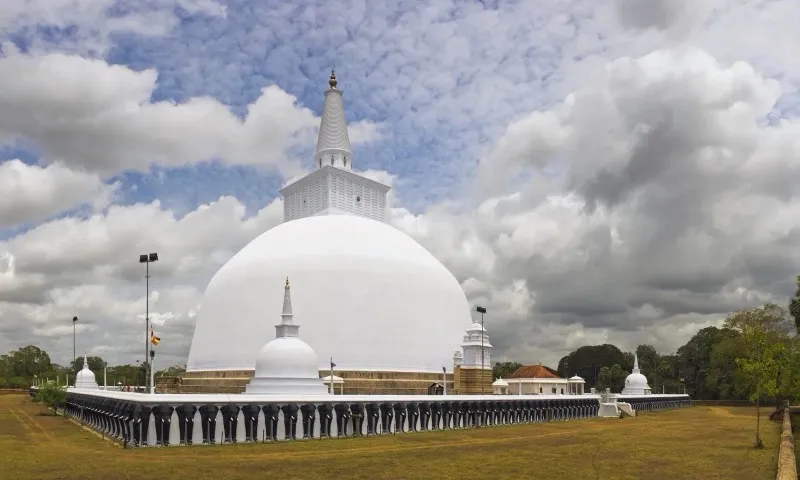
Anuradhapura in a day: what to see in the first capital
One day: the Sri Maha Bodhi, the great dagobas, the Samadhi Buddha and the Twin Ponds. What each is, the US$30 ticket and getting around (Oct 2026).
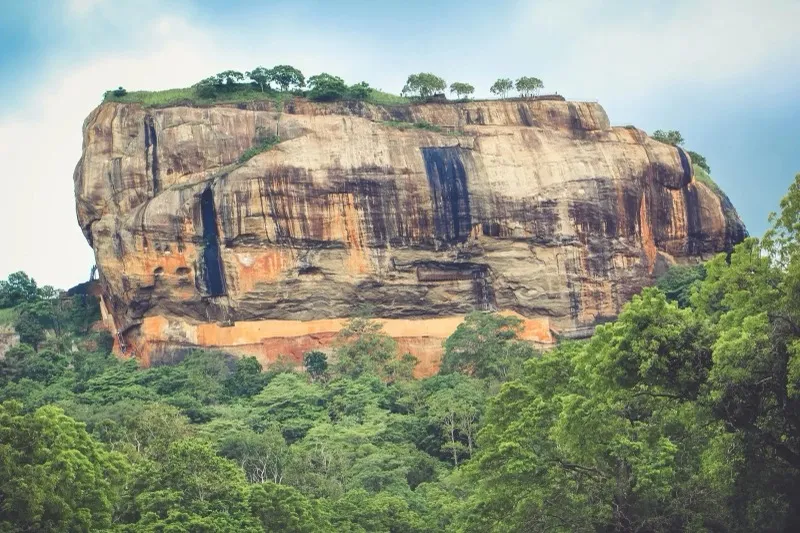
Is Sigiriya worth climbing? What you see, and what most visitors miss
Yes, if you know what you are looking at: a 5th-century royal capital on a 180 m rock. What the climb involves, the fee, and what most visitors miss.
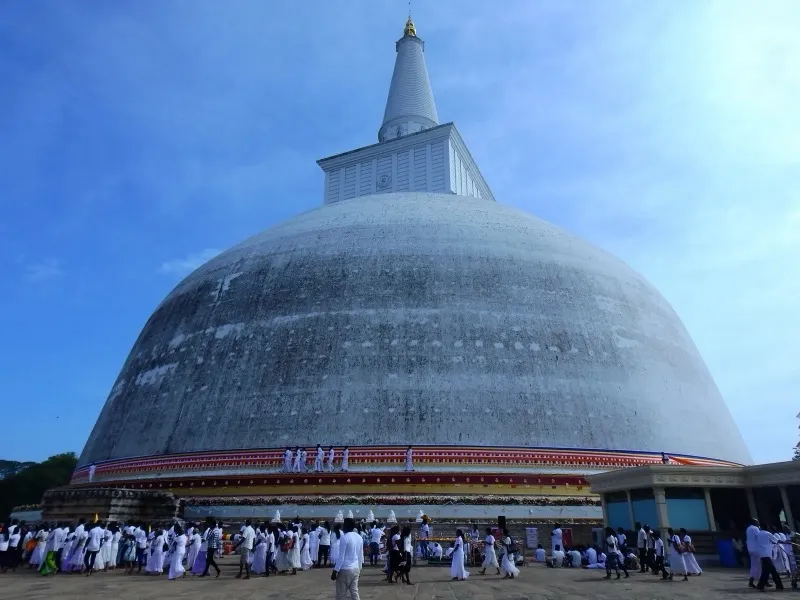
Temple etiquette in Sri Lanka: the rules and the reasons behind them
Shoes and hat off, shoulders and knees covered, never pose with your back to a Buddha. Sri Lanka's temple rules, and why each one matters (October 2026).
More guides in Cultural Triangle