The Gathering at Minneriya: when and why the elephants come
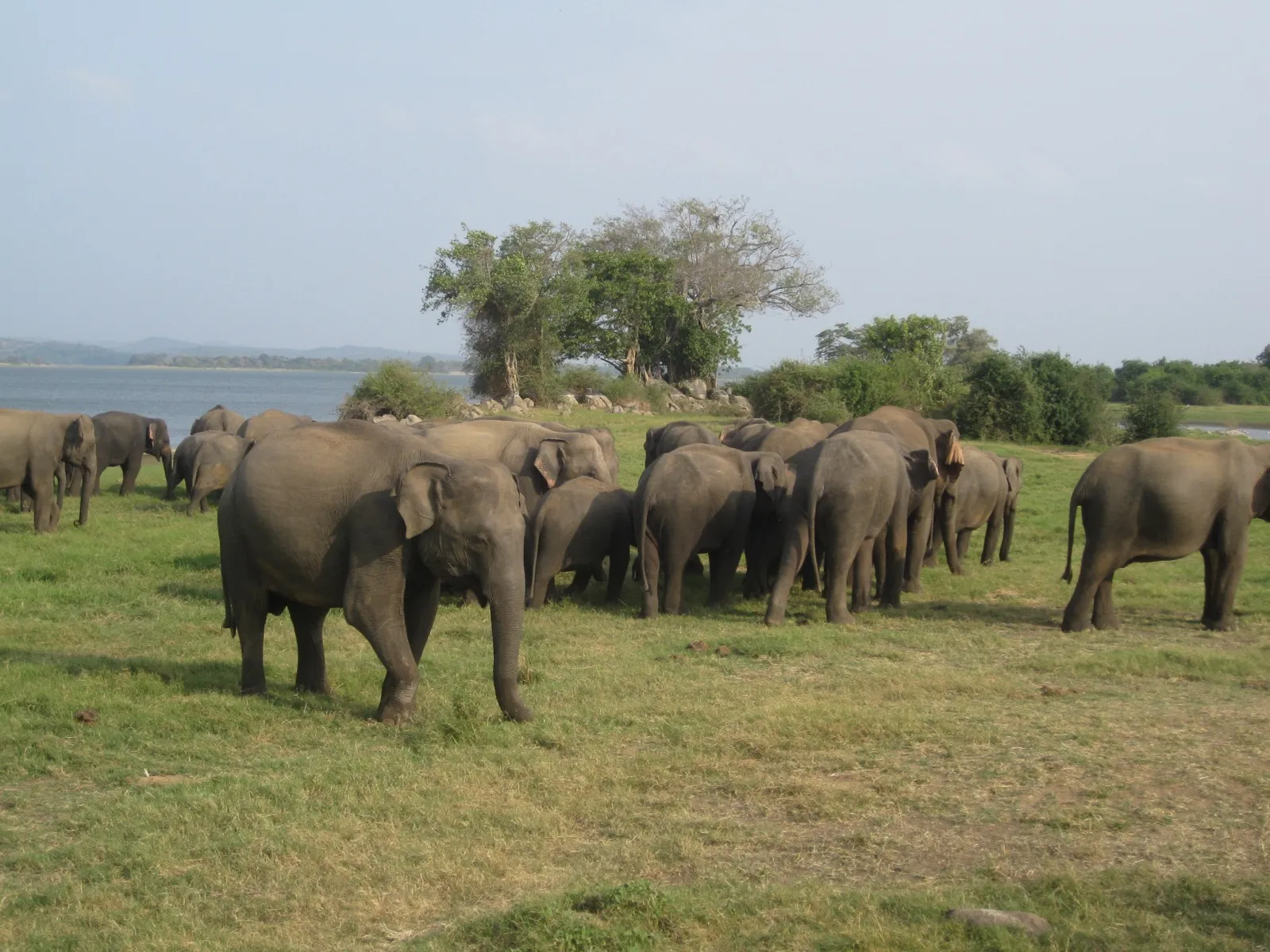
The Minneriya elephant Gathering runs in the dry season, roughly June to October, with numbers usually peaking in late August and September, when researchers estimate that more than 400 elephants feed on the drying reservoir beds of Minneriya and Kaudulla. Sri Lanka Tourism gives May to October. Timing depends on each year's rain, so check recent reports.
This guide explains why the elephants come, how to choose the right park on the day, and how to watch without adding to the crowding.
What is the Minneriya elephant Gathering?
In the dry season the water in the Minneriya and Kaudulla reservoirs goes down, and fresh grass grows on the exposed bed. Elephants come from the surrounding forests to eat it. Researchers estimate that more than 400 elephants gather across the two reservoirs. In a published count at Minneriya alone in 2000 and 2001, the highest number was about 320. Counts there in 2019 and 2020 found no more than 160. Numbers change from year to year and from day to day.
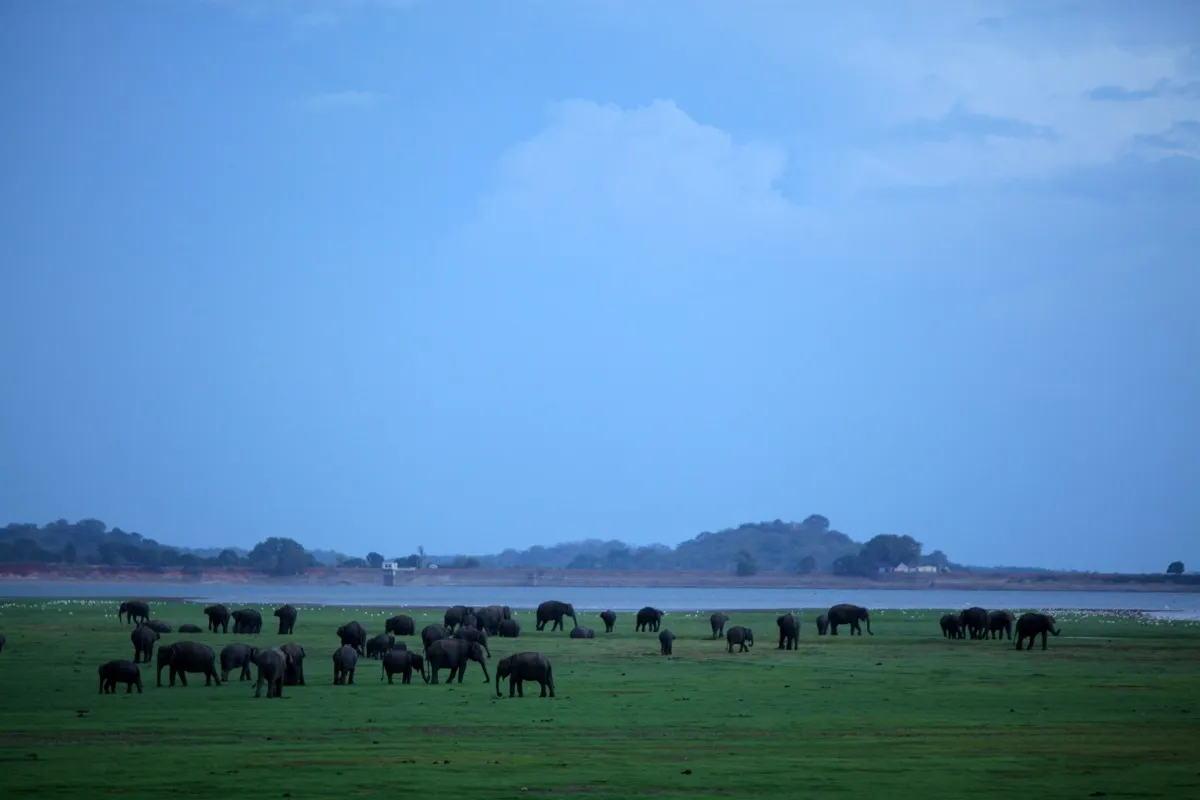
The event is known as "the Gathering", and Sri Lanka Tourism calls it the Elephant Gathering. It is often called the largest gathering of Asian elephants in the world, and Lonely Planet has listed it among the greatest animal wonders on earth.
How old is the Minneriya reservoir?
Minneriya was first protected as a sanctuary in 1938 and became a national park in 1997. The park covers about 89 square kilometres and is run by the Department of Wildlife Conservation.
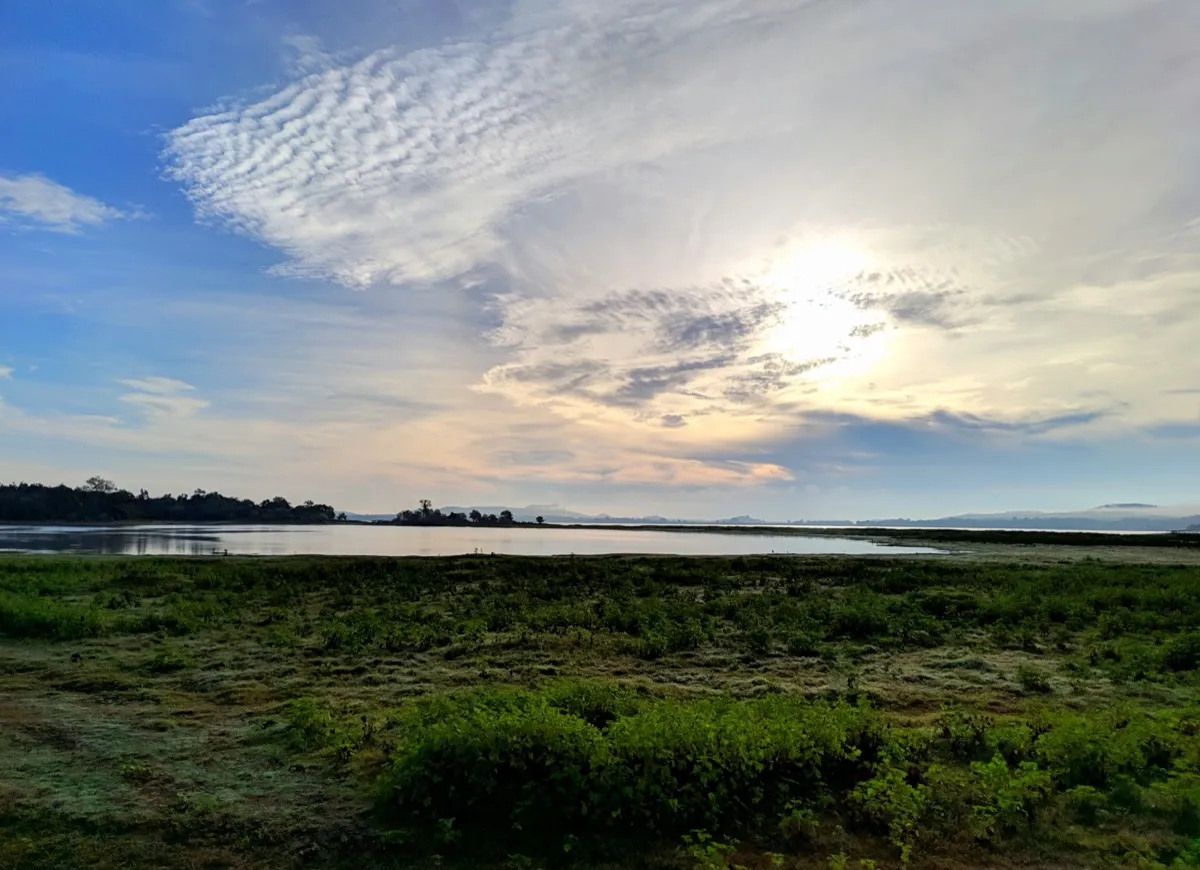
The Minneriya reservoir is ancient. Sri Lankan tradition credits it to King Mahasena, who ruled in the third century CE. A reservoir, called a tank in Sri Lanka, is a lake made by damming water for farming. So, by tradition, the Gathering takes place on a lake made about 1,700 years ago.
Why do the elephants gather at Minneriya?
Asian elephant families split up and come together again, a pattern scientists call fission-fusion. A long study of 286 female elephants at Udawalawe National Park found that small groups seen on any day hide stable, long-term companionships, and that elephants associated more in the dry season.
The Gathering is the most visible form of this: many families sharing one place for a few months. What you watch is not one herd but many, meeting on the same grass.
When is the best time to see the Gathering?
The Gathering happens in the dry season. Sri Lanka Tourism gives May to October as the time to see it; elephant researchers say June to October, and numbers usually peak around late August and September. The timing and the size of the herds depend on each year's rain and water levels, and once the rains set in, the elephants disperse.
There is a newer factor too. The Gathering depends on the water going down. A government audit in 2024 found that a new irrigation project was keeping the Minneriya and Kaudulla reservoirs consistently full, submerging the grasslands elephants feed on and pushing them towards villages. In some years, this may mean fewer elephants on the reservoir bed.
If your trip is in the classic January to March season, the Gathering will not be on. Outside the season, elephants are often seen at Hurulu Eco Park instead. Our guide to when to visit Sri Lanka explains the seasons.
Is morning or afternoon better?
Most Minneriya safaris run in the afternoon, and this is also when the park is busiest. No official or scientific source says elephants are more numerous then, so treat afternoon as custom, not a rule. Daytime visits to Minneriya are allowed from 6 a.m. to 6 p.m.
Minneriya, Kaudulla or Hurulu: which park?
The herds move between Minneriya, Kaudulla National Park to the north, and the Hurulu forest near Habarana. In some weeks Kaudulla has more elephants than Minneriya, and outside the Gathering season the elephants are often seen at Hurulu Eco Park. Drivers in Habarana usually know which park has the herds that week, so ask locally.
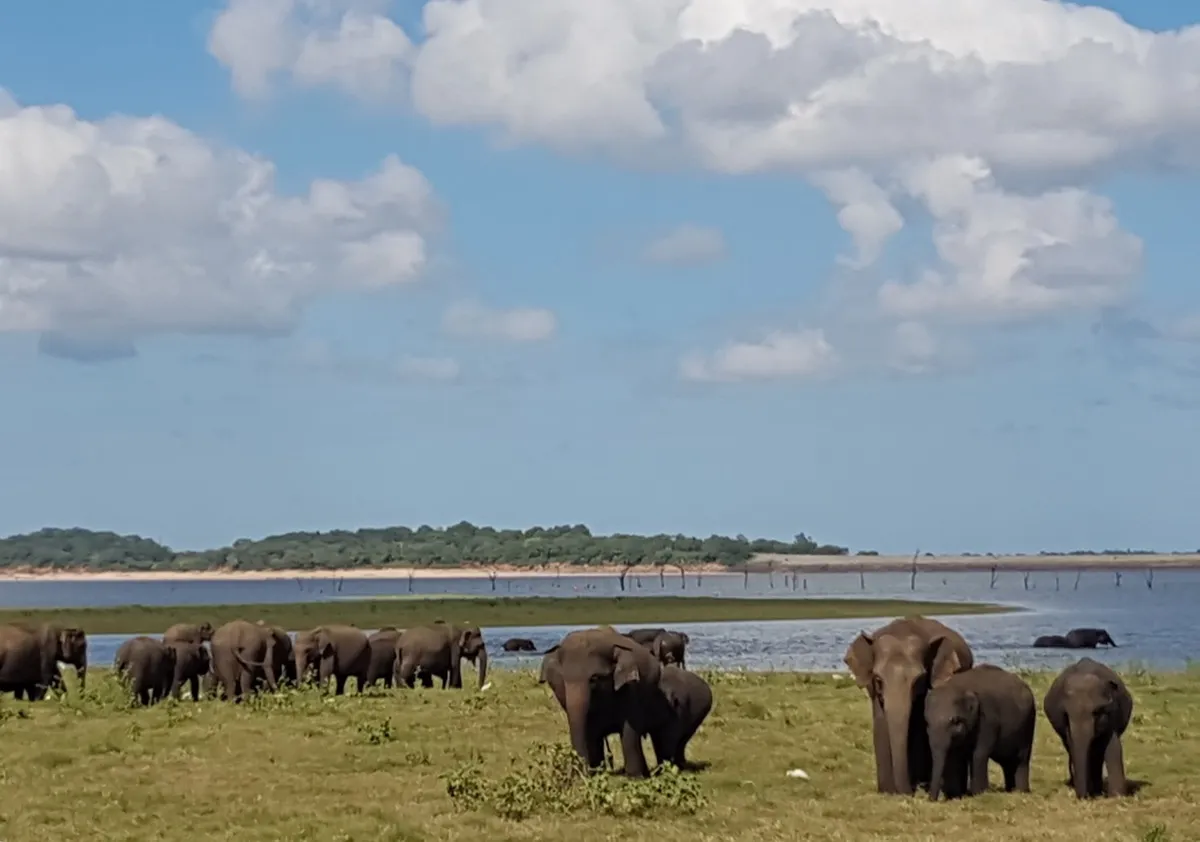
Minneriya is linked to Kaudulla by a protected strip of forest, declared in 2004 as the Kaudulla-Minneriya corridor, and the same elephants range across Minneriya, Kaudulla and the Hurulu forest. Many of them also spend time outside protected areas.
Why is Minneriya so crowded with jeeps?
Minneriya can get very crowded. In August 2026 the government said 400 to 600 jeeps a day enter Minneriya and Kaudulla, and announced plans for a carrying-capacity study, a new entrance and a single ticket for both parks. As checked in October 2026, these were plans, and no daily limit on jeeps was in force.
Minneriya is one of Sri Lanka's busiest national parks. In 2024 it had about 154,000 visitors, roughly half of them from abroad.
In 2026 the Gathering season brought heavy traffic. In August, a park official told the Sunday Times that usually more than 600 safari jeeps entered Minneriya, most of them between 1 and 4 p.m., and safari operators reported waits of up to two hours to buy tickets at the busiest times. To avoid the queue, go in the morning or before the afternoon rush.
How do you watch the Gathering responsibly?
Stay inside the jeep. Do not feed any animal. Keep quiet and do nothing that disturbs the elephants; causing a disturbance in a national park is against the law, and a jeep operator whose passengers break the rules can be banned from the park for at least six months.
The legal speed limit inside the park is 20 kilometres an hour. Ask your driver to keep a good distance and never to block an elephant's path, and do not ask to get closer.
Do not ride an elephant, and do not take part in activities where you feed, bathe or touch elephants. Elephants used for these activities are usually trained with harsh methods when young, and they spend their lives in captivity. Watching wild elephants in a park, from a distance, is the better choice.
Are there wild elephants outside the park?
Wild elephants also live outside the park, in the forest around Sigiriya and Habarana. In February 2026 a visitor walking back to his hotel near Pidurangala was killed by a wild elephant. Do not walk these roads in the dark; take a tuk-tuk.
Around Minneriya, as across Sri Lanka's dry zone, elephants and farmers compete for land. In recent years, conflict with people has killed several hundred elephants and more than a hundred people in Sri Lanka every year, most elephants by gunshot, electrocution, trains and explosive bait.
How much are the Minneriya park fees?
You need a park permit for each visit. Your jeep driver usually buys it at the gate, or it can be booked online through the Department of Wildlife Conservation's e-permit service. Carry your passport: no one is let in without an identity document.
The national park fees in force were set by Government Gazette 2292/11, published on 8 August 2022, and have applied since 2 September 2022. As checked in October 2026, this was the latest official fee table we could confirm. Minneriya and Kaudulla are in the same fee band as Yala.
- A foreign adult pays 25 US dollars for a daytime visit in the tourist season, or 20 dollars at other times.
- A child aged 6 to 12 pays 15 or 10 dollars, and children under 6 enter free.
- Each group also pays a service charge of 10 dollars per vehicle, and a jeep fee of 300 rupees.
- Taxes are added on top, so the final price is higher.
What does a Minneriya safari cost?
Jeep hire is a private price, so agree it with your driver or hotel before you go. At the gate, a foreign visitor typically pays around 11,000 rupees in park charges, including tax and service charges, according to a safari operator quoted in August 2026. Most safaris are afternoon half-day drives, and the park closes at 6 p.m.
How far is Minneriya from Sigiriya and Habarana?
The main Minneriya entrance is on the Habarana-Polonnaruwa road. It is about 9 kilometres from Habarana, about 15 to 30 minutes by road, and about 20 kilometres from Sigiriya village, about 30 to 45 minutes (estimates, checked October 2026). That makes it easy to combine with Sigiriya or Polonnaruwa.
What most visitors miss at Minneriya
- The lake is man-made and ancient. Tradition credits it to a third-century king.
- It is many families, not one herd.
- The park changes week to week. Ask in Habarana whether Minneriya, Kaudulla or Hurulu has the elephants.
- Full reservoirs can mean fewer elephants. The 2024 audit found water levels kept high.
- Elephants live outside the park too. Do not walk the roads after dark.
Before you go to the Gathering
- Travel between about June and October for the best chance, and check recent reports for that year.
- Ask your driver in Habarana which park has the herds that week.
- Carry your passport for the permit.
- Expect the 2022 fees plus vehicle charges and taxes (as checked October 2026).
- Ask your driver to keep distance, keep to 20 km/h and never block an elephant.
- Take a tuk-tuk, not a walk, after dark.
Questions people ask
When is the Minneriya elephant Gathering?
In the dry season. Sri Lanka Tourism gives May to October; elephant researchers say June to October, and numbers usually peak around late August and September. The timing depends on each year's rain.
How many elephants gather at Minneriya?
Researchers estimate that more than 400 elephants gather across the Minneriya and Kaudulla reservoirs. In a published count at Minneriya alone in 2000 and 2001, the highest number was about 320. Counts there in 2019 and 2020 found no more than 160. Numbers change from year to year and day to day.
Minneriya or Kaudulla?
The herds move between Minneriya, Kaudulla and the Hurulu forest. In some weeks Kaudulla has more elephants than Minneriya, so ask drivers in Habarana which park has the herds that week.
Can you see the Gathering in February?
No. The Gathering happens in the dry season, roughly May or June to October. Outside the season, elephants are often seen at Hurulu Eco Park instead.
How far is Minneriya from Sigiriya?
About 20 kilometres from Sigiriya village, about 30 to 45 minutes by road, and about 9 kilometres from Habarana (estimates, checked October 2026).
Coming soon: Sri Lanka Before You Land, our pre-trip ebook, explains how to watch Sri Lanka's wildlife without harming it. A free guide, Your First Week in Sri Lanka, will cover the first days on the ground.
Sources (32)
Every fact in this guide was checked against these sources on 3 October 2026. Official and primary sources come first. How we research.
- DWC notice 'Revision of Fees - Visitor Services' (1 Sep 2022), citing Gazette 2292/11 · dwc.gov.lk
- DWC, Day Visitor ePermit how-to · dwc.gov.lk
- DWC Wildlife Park Permits Reservation eService · dwc.lankagate.gov.lk
- Fauna and Flora Protection Ordinance (consolidated), FAOLEX copy · faolex.fao.org
- Department of Wildlife Conservation, Performance Report 2024 (tabled in Parliament), tables 2.3.6-2.3.7 · parliament.lk
- SLTDA, Guideline for Vehicle Safari Tour Operations (Feb 2024) · sltda.gov.lk
- Sri Lanka Tourism Promotion Bureau (official), Minneriya National Park page · srilanka.travel
- UNESCO Man and the Biosphere, Hurulu Biosphere Reserve · unesco.org
- Fernando, Jayewardene, Prasad, Hendavitharana & Pastorini 2011, 'Current Status of Asian Elephants in Sri Lanka', Gajah 35:93-103 (two DWC co-authors) · asesg.org
- Karunatilaka, Pilapitiya et al. 2021, Gajah 54: Minneriya counts (319 in 2000/01 citing Santiapillai et al. 2003; max 160 in 2019-20); ~400 estimated across Minneriya and Kaudulla · asesg.org
- Green, Schmidt-Burbach et al. 2025, Frontiers in Ethology · doi.org
- de Silva, Ranjeewa & Kryazhimskiy 2011, 'The dynamics of social networks among female Asian elephants', BMC Ecology 11:17 · doi.org
- Mahavamsa ch. 37 (Geiger translation, 1912), reign of Mahasena · lakdiva.org
- Gazette Extraordinary No. 2292/11 of 8 Aug 2022, wildlife visitor-fee regulations under the FFPO · web.archive.org
- Ada Derana, 15 Jun 2026, visitors arrested for leaving vehicles in Yala · adaderana.lk
- Ceylon Today, 16 Aug 2025, 'The Overtourism Dilemma in Sri Lanka' · ceylontoday.lk
- Ceylon Today, 18 Feb 2026 · ceylontoday.lk
- Ceylon Today, 20 Oct 2025, reporting the National Audit Office 2024 performance audit of DWC · ceylontoday.lk
- Ceylon Today, 26 Dec 2025, elephant deaths citing DWC figures · ceylontoday.lk
- Lonely Planet, Zinara Rathnayake, '16 Tips for Keeping Costs Low...' · lonelyplanet.com
- Sri Lanka Tourism Alliance (industry body), 'All about the Gathering' · lovesrilanka.org
- Mongabay, Jun 2020, 'Sri Lanka reopens national parks post-lockdown with strict guidelines' · news.mongabay.com
- Mongabay, Malaka Rodrigo, 23 Jul 2020, 'Twins highlight world's largest Asian elephant gathering in Sri Lanka' · news.mongabay.com
- Newswire, 17 Aug 2026, 'Govt moves to strengthen wildlife conservation and tourism management' (Ministry of Environment, after Deputy Minister's tour of Minneriya, Kaudulla and Hurulu) · newswire.lk
- Newswire, 31 Mar 2025, 'A battle for survival: Sri Lanka's escalating Human Elephant Conflict' · newswire.lk
- OSRM route on OpenStreetMap data, Habarana town to 'Minneriya National Park Entrance' gate node · router.project-osrm.org
- OSRM route on OpenStreetMap data, Sigiriya village to 'Minneriya National Park Entrance' gate node · router.project-osrm.org
- Sunday Times, 22 Feb 2026, 'Pidurangala's pachyderm problem needs sustainable solution' · sundaytimes.lk
- The Sunday Times (Sri Lanka), Dilushi Wijesinghe, 16 Aug 2026, 'Minneriya elephant joy soiled by ticketing hassles and massive vehicle jam' · sundaytimes.lk
- IWMI Sri Lanka Wetlands Database, Kaudulla profile (2006; archived 2011) · web.archive.org
- IWMI Sri Lanka Wetlands Database, Minneriya reservoir profile (2006; archived 2011) · web.archive.org
- World Animal Protection, Taken for a Ride (2017) · worldanimalprotection.org
Related guides
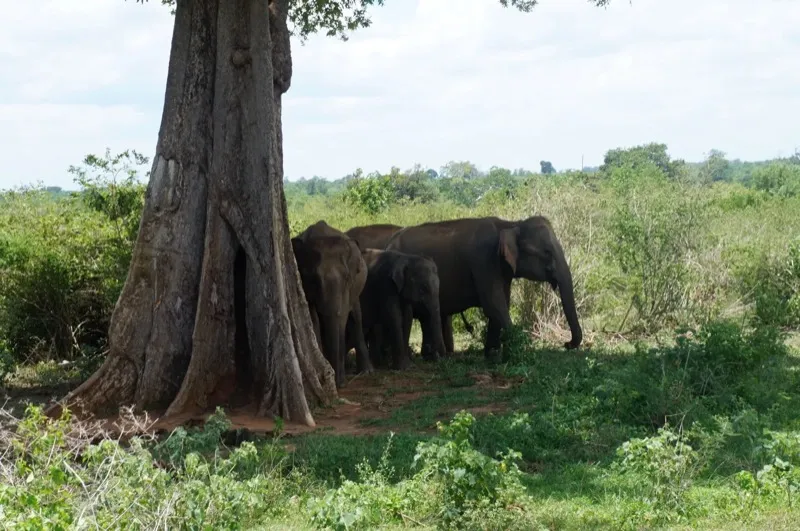
Udawalawe: elephants in the wild, and the transit home
One of the most reliable places to see wild elephants, in any month. The safari, the Elephant Transit Home, and how to watch responsibly (Oct 2026).
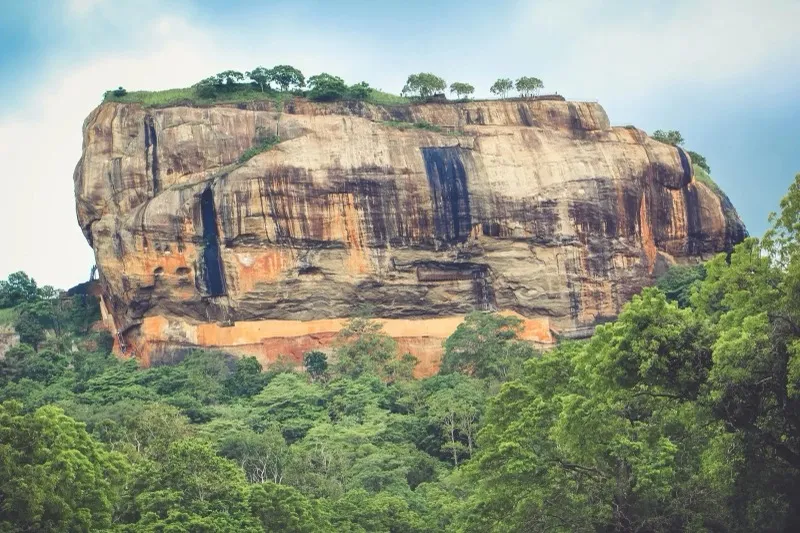
Is Sigiriya worth climbing? What you see, and what most visitors miss
Yes, if you know what you are looking at: a 5th-century royal capital on a 180 m rock. What the climb involves, the fee, and what most visitors miss.
When to visit Sri Lanka: the two monsoons, explained
For the classic loop, January to March is driest. The east coast is best April to September. How the two monsoons decide your route, month by month.
More guides in Cultural Triangle · Wildlife