Sri Lankan food: what to order, and what it is
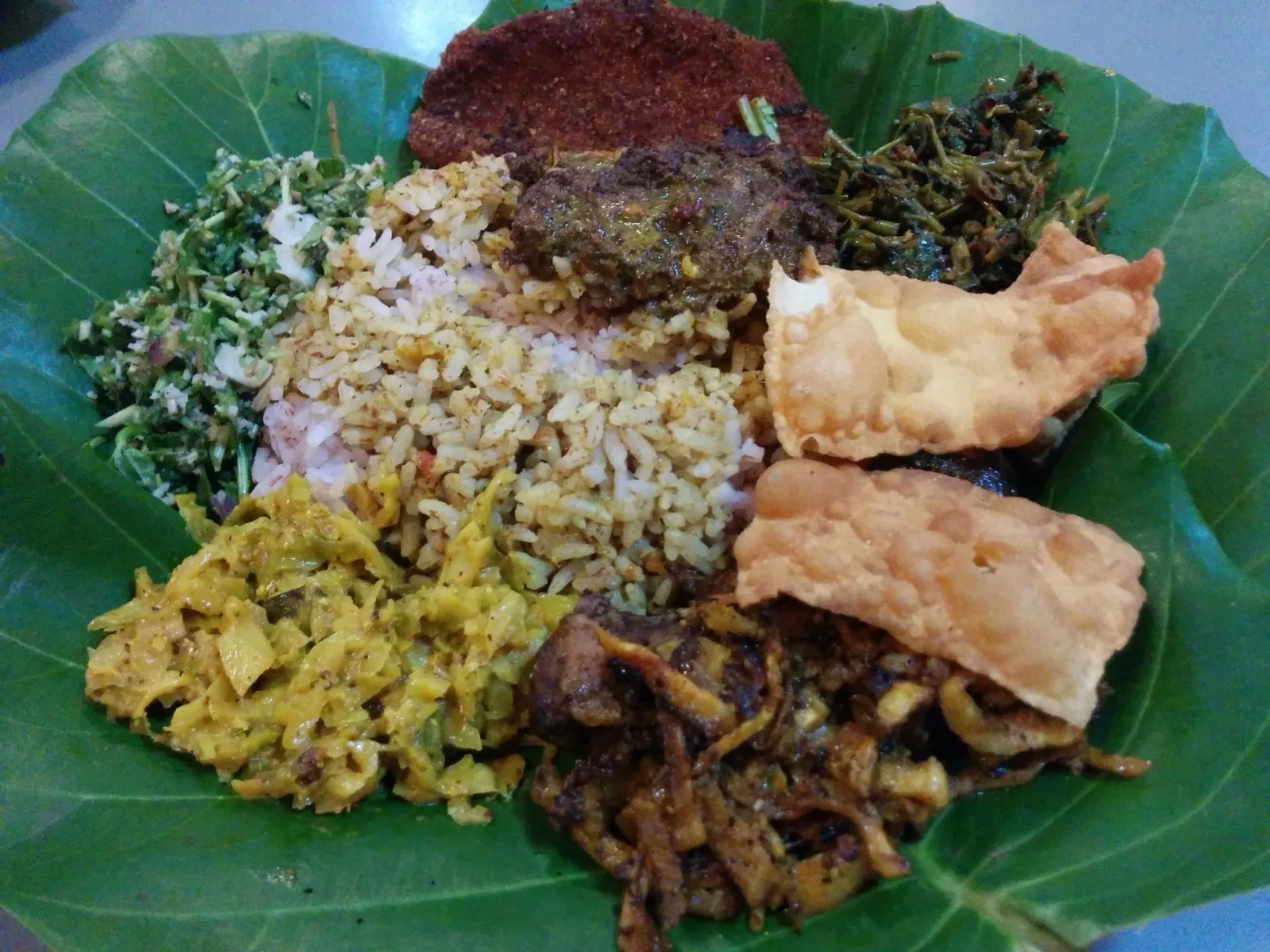
Start with rice and curry at lunch: rice with a mild lentil dhal, two or three vegetable curries and a coconut sambol. In the evening, try hoppers, bowl-shaped rice-flour pancakes, or kottu, chopped flatbread fried with vegetables or meat. Ask for "less spicy" if you need to, and if you are vegetarian, ask about Maldive fish.
That covers your first day. The rest of this guide explains what each dish is, when people eat it, and the few questions worth asking before you order.
Sri Lankan dishes to try
- Rice and curry: rice with a dhal, vegetable curries and a sambol; the everyday lunch.
- Pol sambol: a fresh coconut relish with chilli, onion and lime.
- Hoppers and egg hoppers: bowl-shaped rice-flour pancakes.
- String hoppers: steamed nests of rice-flour noodles.
- Kottu: chopped flatbread fried with vegetables, egg or meat.
- Lamprais: rice and curries baked in a banana leaf.
- Kiribath: milk rice for special days.
- Polos: young jackfruit curry.
- Short eats: patties, rolls, vadai and fish buns.
- Thambili: king coconut water.
- Jaffna crab curry: mud crab in a hot northern spice mix.
- Curd and treacle: buffalo curd with kithul palm syrup.
- Watalappan: a steamed jaggery custard.
What is rice and curry?
Rice and curry is the everyday meal of Sri Lanka: a plate of rice, white or red, with several small curries. Expect:
- Dhal curry (parippu): red lentils cooked with coconut milk and spices. It is usually the mildest dish on the plate and comes with almost every rice and curry.
- Two or three vegetable curries.
- Often a fish or chicken curry.
- A mallung: finely chopped greens or another vegetable, cooked lightly with grated coconut.
- A sambol: a fresh relish.
In local eating places, rice and curry is sold mainly at lunchtime. At lunchtime, small shops also sell lunch packets (also called rice packets): rice and curry wrapped up to take away.
One curry to look for is polos: young, unripe jackfruit, cooked as a rich brown curry. The texture is often compared to meat, but it is a vegetable dish.
Is Sri Lankan food vegetarian-friendly?
Pol sambol is the most common sambol: fresh grated coconut with chilli, red onion, lime juice and salt. It often also contains Maldive fish, so it is not always vegetarian.
Maldive fish (umbalakada in Sinhala) is dried tuna, usually skipjack, sold as hard chips or flakes. Cooks use small amounts to season sambols and even vegetable curries, so a dish with no visible meat may still contain fish. If you are vegetarian, say so clearly and ask whether a dish has fish in it.
What are hoppers and string hoppers?
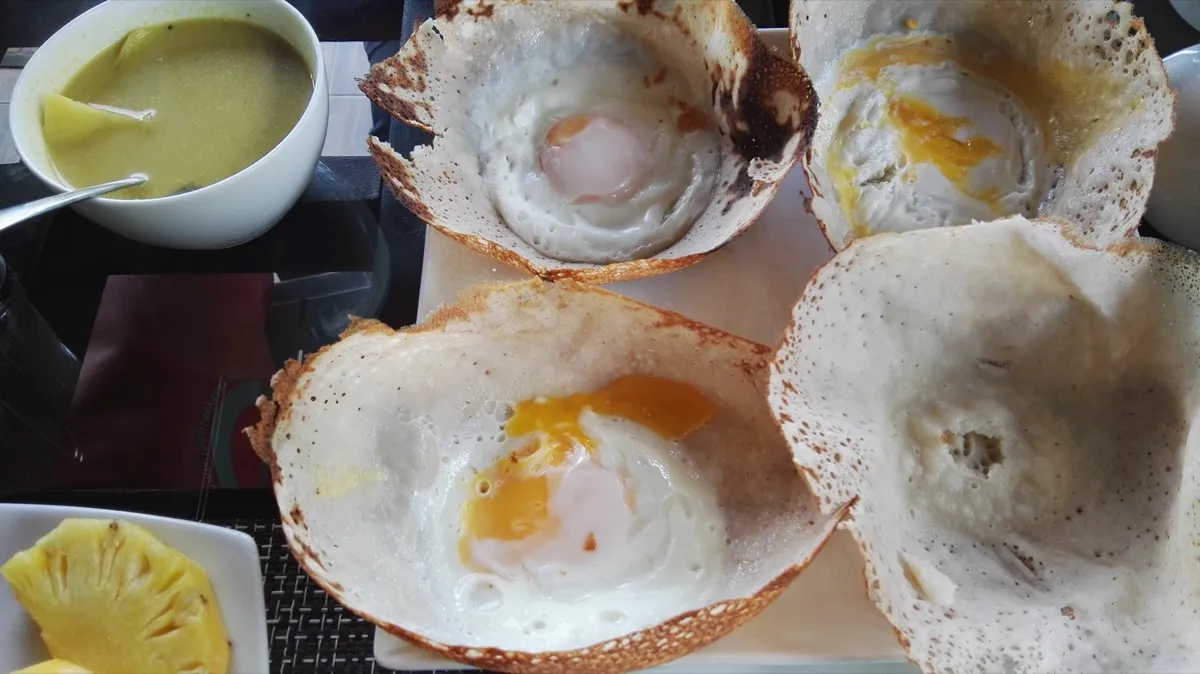
Hoppers (appa in Sinhala, appam in Tamil) are bowl-shaped pancakes made from a fermented batter of rice flour and coconut milk, crisp at the edges and soft in the middle. An egg hopper has an egg cooked in the centre. People eat them for breakfast and in the evening, with a sambol or a curry.
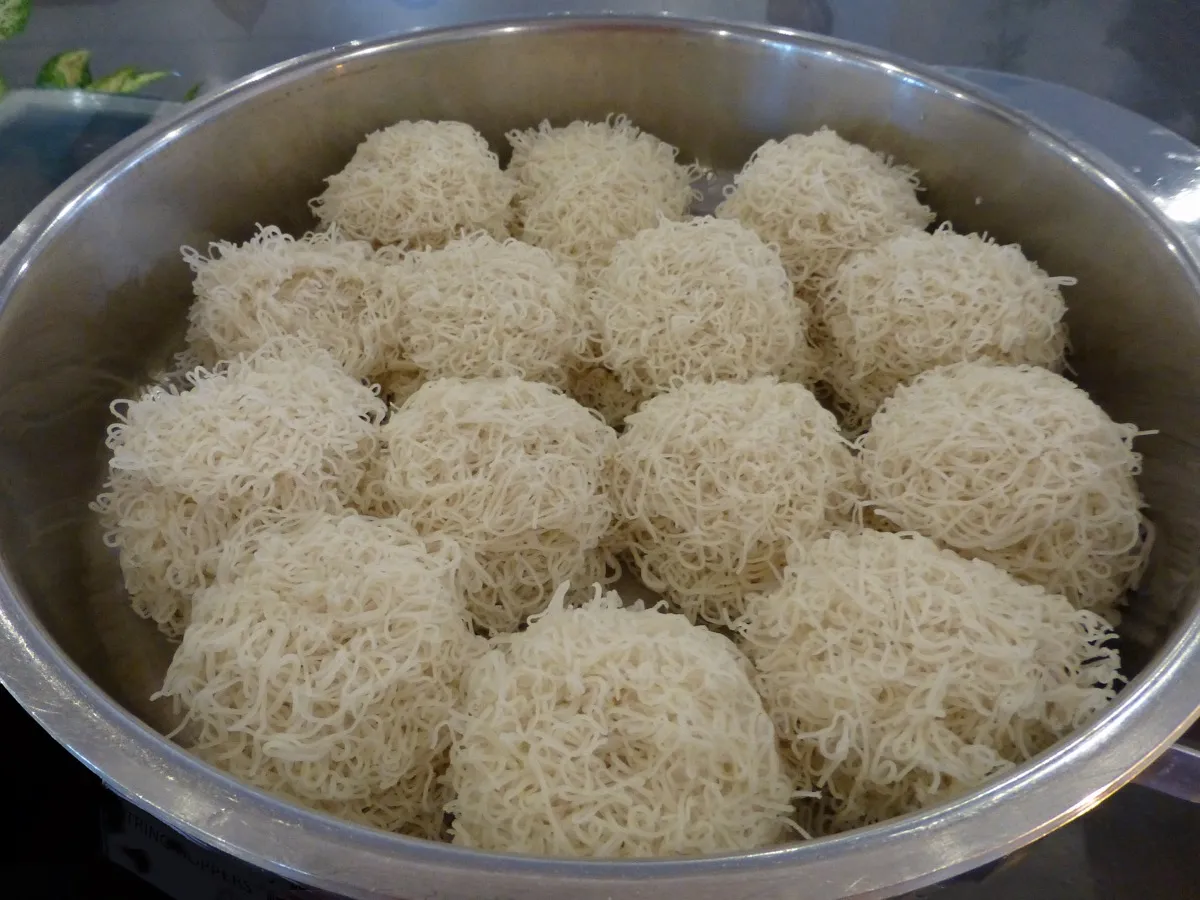
String hoppers (indiappa in Sinhala, idiyappam in Tamil) are small nests of thin rice-flour noodles, steamed, and eaten with a curry and pol sambol, usually at breakfast or dinner.
What is kottu?
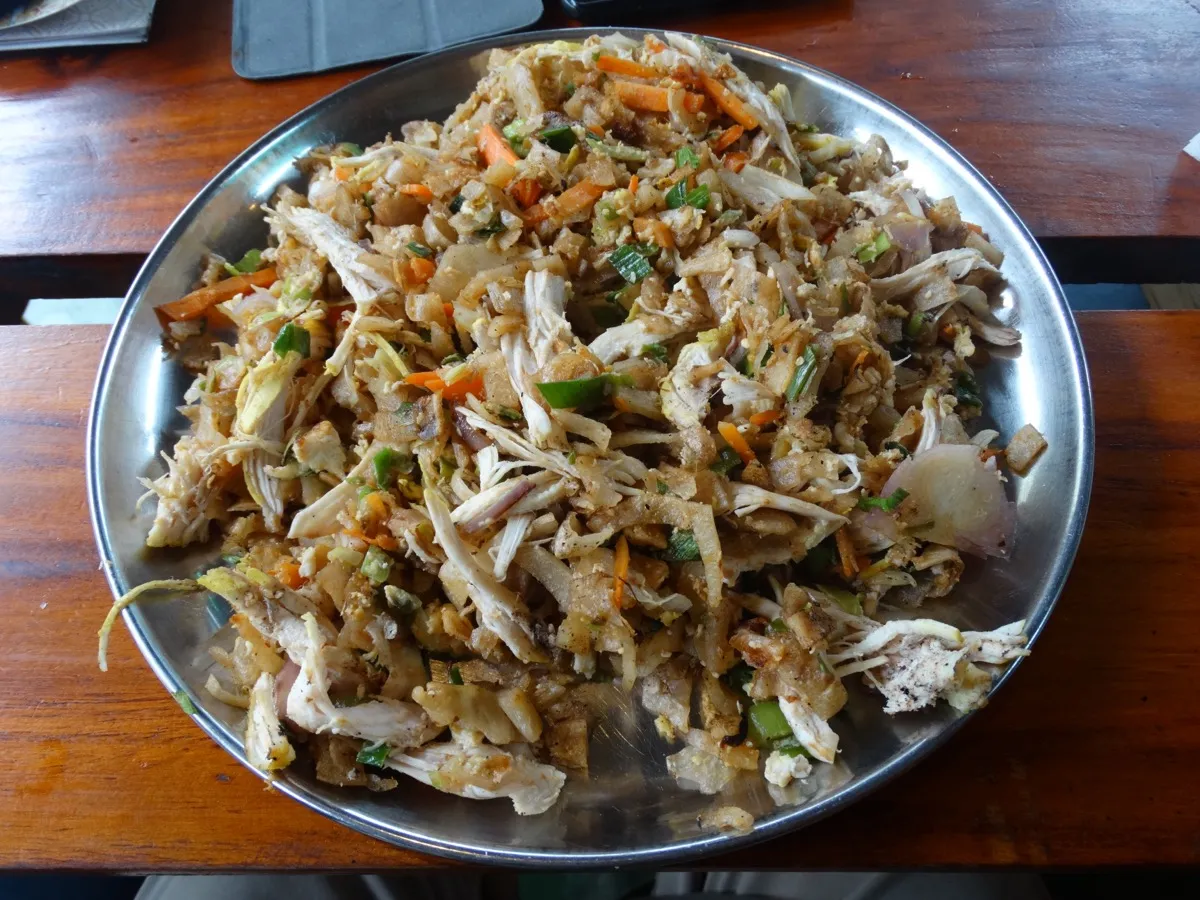
Kottu is chopped flatbread, called godamba roti, fried on a hot iron plate with vegetables, egg or meat. The cook chops it with two metal blades in a fast, loud rhythm, so in the evening you often hear kottu being made before you see it. The name comes from the Tamil word for "to chop".
What do Sri Lankans eat for breakfast?
A Sri Lankan breakfast is often hoppers or string hoppers, eaten with pol sambol and dhal curry. Pol roti, a coconut flatbread with chilli sambol, is another breakfast favourite. Pittu, steamed rice flour and coconut, is also eaten with curry. Kiribath, milk rice, is the dish of special days such as New Year, though some restaurants serve it at breakfast every day.
What seafood should you try?
On the coast, seafood is fresh and easy to find: fish, prawns, crab and squid. In Galle and the south, look for crab curry, prawn curry and fish ambul thiyal, a southern fish curry. In the north, Jaffna crab curry is the famous dish: mud crab in a hot northern spice mix, eaten with rice.
Which dishes come from the island's history?
Sri Lankan food carries the island's history. Tamil cooking brings thosai, idli and vadai. Sri Lankan Muslim cooking draws on Arab, Indian and Malay traditions. The Portuguese brought red chillies into common use, and the Dutch Burghers gave the island lamprais.
- Lamprais: rice cooked in stock, with curries, a sambol and a meatball, wrapped in a banana leaf and baked. It comes from the Dutch Burgher community, Sri Lankans with partly Dutch ancestry.
- Kiribath (milk rice): rice cooked in coconut milk, pressed into a flat block and cut into pieces. It is the food of special days: the Sinhala and Tamil New Year in mid-April, Poya days and family celebrations.
- Watalappan: a steamed custard of coconut milk, eggs, jaggery and spices. Jaggery is a dark sugar made from palm sap. It is linked with Sri Lanka's Muslim and Malay communities.
What are short eats?
Short eats are small snacks from bakeries and cafes: patties (pastry with a curry filling), rolls (pancakes rolled around a filling, crumbed and fried), vadai (fried lentil cakes), cutlets and fish buns.
In some cafes a plate of mixed short eats is put on your table; you pay only for what you eat.
What should you drink, and what is for dessert?
- Thambili: king coconut, an orange coconut. The seller cuts it open in front of you and you drink the water with a straw. It is cheap and refreshing.
- Wood apple: a hard-shelled fruit with a sour, brown pulp. It is often made into a drink.
- Ceylon tea: tea grown in Sri Lanka; Ceylon is the island's old name. Tea planting began in 1867 on Loolecondera estate near Kandy. In local places, tea usually comes with milk and sugar already added. "Plain tea" means black tea, but normally still sweet, so ask for "plain tea, no sugar".
- Curd and treacle: for dessert, thick buffalo-milk curd with a dark syrup made from the sap of the kithul palm.
How much does a meal cost?
In January 2025, Lonely Planet put a plate of rice and curry at about 600 to 1,600 rupees: the low end in small local eating places, more in tourist areas. Prices may be a little higher now (checked October 2026). See money in Sri Lanka.
Is Sri Lankan food very spicy?
Sri Lankan food can be very hot. Say "less spicy, please", or in Sinhala saera adu karala denna. Taste a little of each dish first. If something is too hot, a spoon of curd or a glass of milk helps most; more rice helps too; water helps only a little.
The dhal is usually the mildest dish on the plate, so it is a good place to start.
Do you eat with your hands in Sri Lanka?
Many Sri Lankans eat rice and curry with their fingers, using only the right hand. You do not have to: asking for a spoon and fork is a normal request. If you try it, wash your hands first and keep your left hand off the food; use your right hand to pass or take things.
Why is a café called a "hotel" in Sri Lanka?
In Sri Lanka, a small, cheap eating place is often called a "hotel", even when it has no rooms. A "Hotel" sign over a roadside cafe usually means food, not beds.
Can you get meat and alcohol on Poya days?
Many Hindus and many Buddhists do not eat beef, and some Buddhists eat no meat. Muslims do not eat pork, and eat meat that is halal. Beef and pork are on many menus, but not in every home or restaurant.
Every full moon is a Poya day, a Buddhist holy day and a public holiday. By law, meat stalls, bars and liquor shops close, and no one may slaughter animals for sale or sell meat. Many Buddhists eat no meat that day. Restaurants still serve food, but menus may be limited, and do not count on buying alcohol.
Is it safe to eat street food and drink the water?
Health agencies advise visitors to take care with food and water in Sri Lanka. Drink bottled water with an unbroken seal, or water that has been boiled or treated, and be careful with ice. Food that is cooked fresh and served hot is generally safer than food that has been standing. Peel fruit yourself.
What most visitors miss about Sri Lankan food
- Rice and curry is a lunch meal in local places. In the evening, look for hoppers and kottu.
- "Vegetarian" may still mean Maldive fish. Ask.
- A "hotel" may be a cafe.
- Short eats are paid by what you eat, not by the plate.
- Tea comes sweet unless you ask.
- Milk or curd, not water, is the answer to a dish that is too hot.
Before your first Sri Lankan meal
- Learn one phrase: saera adu karala denna, "less spicy, please".
- If vegetarian, ask about Maldive fish at every meal.
- Try rice and curry at lunch, hoppers or kottu in the evening.
- Ask for "plain tea, no sugar" if you want it unsweetened.
- Use your right hand, or ask for a spoon and fork.
- Drink sealed bottled water and be careful with ice.
- On a Poya day, expect limited menus and no alcohol sales.
Questions people ask
What Sri Lankan food should I try first?
Rice and curry at lunch, then hoppers or kottu in the evening. Add string hoppers for breakfast, short eats from a bakery, and curd and treacle for dessert. Kiribath is food for special days, but many restaurants now serve it at breakfast.
Is pol sambol vegetarian?
Not always. It often contains Maldive fish, dried tuna used to season sambols and even vegetable curries. If you are vegetarian, ask whether a dish has fish in it.
How do I ask for less spicy food?
Say "less spicy, please", or in Sinhala saera adu karala denna. If something is too hot, a spoon of curd or a glass of milk helps most.
Is it rude to eat with a fork in Sri Lanka?
No. Many Sri Lankans eat rice and curry with their fingers, using only the right hand, but asking for a spoon and fork is a normal request.
Can you drink the tap water in Sri Lanka?
Health agencies advise care. Drink bottled water with an unbroken seal, or water that has been boiled or treated, and be careful with ice.
Coming soon: Sri Lanka Before You Land, our pre-trip ebook, explains the customs behind daily life on the island, from temples to the table. A free guide, Your First Week in Sri Lanka, will cover the first days on the ground.
Sources (25)
Every fact in this guide was checked against these sources on 3 October 2026. Official and primary sources come first. How we research.
- Holidays Act No. 29 of 1971, arrangement of sections (most.gov.lk) · most.gov.lk
- Nolden, Lenart & Hayes, 'Putting out the fire', Physiology & Behavior 208:112557, 2019 · pmc.ncbi.nlm.nih.gov
- Australian Government Smartraveller, Sri Lanka, Local laws · smartraveller.gov.au
- Sri Lanka Tourism Promotion Bureau, Culinary tourism page · srilanka.travel
- Sri Lanka Tourism Promotion Bureau, Food page · srilanka.travel
- Sri Lanka Tea Board, History of Ceylon Tea · srilankateaboard.lk
- CDC Travelers' Health, Food and Water Safety (6 Jan 2026) · wwwnc.cdc.gov
- Sri Lanka Tea Board, Pure Ceylon Tea, 'Story' · pureceylontea.com
- Qur'an 2:173 (Saheeh International) · quran.com
- NaTHNaC TravelHealthPro, Food and water hygiene factsheet · travelhealthpro.org.uk
- Weerasekara et al., 'Nutrition Transition and Traditional Food Cultural Changes in Sri Lanka during Colonization and Post-Colonization', Foods 7(7):111, 2018 · pmc.ncbi.nlm.nih.gov
- DK Eyewitness Travel Guide: Sri Lanka (2016), food section, Internet Archive full-text snippets · archive.org
- Karan Gokani, Hoppers: The Cookbook (Quadrille, 2022) · archive.org
- Michael Meyler, A Dictionary of Sri Lankan English (Colombo, 2007) · archive.org
- Daily Mirror (Colombo), 4 Apr 2025, Excise closure order with hotel exemption (New Year) · dailymirror.lk
- Great British Chefs, Pol sambol recipe · greatbritishchefs.com
- Holidays Act No. 29 of 1971, full text (ss.2, 13, 14), lankalaw.net private law-reference host · lankalaw.net
- Lonely Planet, Zinara Rathnayake, '16 Tips for Keeping Costs Low...' · lonelyplanet.com
- Lonely Planet, Zinara Rathnayake, 'What to eat and drink in Sri Lanka' · lonelyplanet.com
- Love Sri Lanka (Sri Lanka Tourism Alliance), 'The Taste of Sri Lanka' (modified 13 Dec 2024) · lovesrilanka.org
- Madura English-Sinhala Dictionary online, 'strong' (sera) · maduraonline.com
- Rough Guides, Customs and etiquette in Sri Lanka · roughguides.com
- Asiff Hussein, 'The origins of some Sri Lankan Muslim foods and beverages', Sailan Muslim Foundation · sailanmuslim.com
- TravelHealthPro (UK NaTHNaC), Sri Lanka country page · travelhealthpro.org.uk
- Wim Van Daele, 'The meaning of culture-specific food: rice and its webs of significance in Sri Lanka', Omertaa Journal of Applied Anthropology · web.archive.org
Related guides
Temple etiquette in Sri Lanka: the rules and the reasons behind them
Shoes and hat off, shoulders and knees covered, never pose with your back to a Buddha. Sri Lanka's temple rules, and why each one matters (October 2026).
Money in Sri Lanka: cash, cards, ATMs and tipping
Use both. Cards work at hotels and larger shops; carry rupees in small notes for tuk-tuks, buses and small shops. ATMs, fees and tipping (October 2026).

Sri Lanka in two weeks: the classic loop, explained day by day
Two weeks in Sri Lanka: Cultural Triangle, Kandy, the hills, Ella, Yala and the south coast. Day by day, with honest travel-time ranges (checked October 2026).
More guides in Culture and etiquette